



A More Refined Expression of the Lumina V
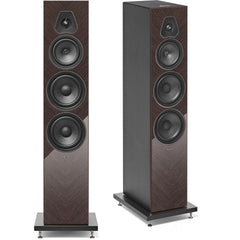
The Sonus Faber Lumina V Amator floorstanding speakers build on the original Lumina V with a redesigned crossover network, exclusive high-gloss wood finishes, and engineering influenced by models much higher in the Sonus Faber range.
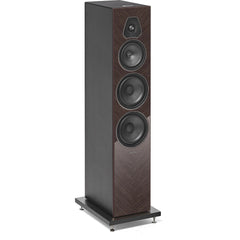
The Lumina V Amator retains the slender proportions, true three-way driver configuration, dual woofers, and room-friendly down-firing reflex port of the standard Lumina V. Its revised crossover moves the transition between the dedicated midrange and tweeter from 2,600Hz to 2,850Hz, with the goal of improving driver integration, phase behavior, resolution, and overall coherence.
Made at Sonus Faber’s facility in Vicenza, Italy, the Lumina V Amator is designed for listeners who want full-range performance, expressive vocals, convincing bass, and premium craftsmanship without moving into a much larger loudspeaker.
- Three-way vented floorstanding loudspeaker
- Revised crossover network with a 2,850Hz upper crossover point
- 29mm D.A.D. soft-dome tweeter
- 150mm dedicated paper and natural-fiber midrange driver
- Two 165mm woofers with sandwich-construction diaphragms
- Down-firing reflex port for flexible room placement
- Internal lute-shaped midrange and tweeter chamber
- High-gloss multilayer wood front baffle
- Black leather cabinet covering
- Bi-wire and bi-amp capable binding posts
- Made in Vicenza, Italy
- Priced and packaged as one stereo pair
What Makes the Lumina V Amator Different?
The Lumina V Amator is not merely the standard Lumina V in a different finish. Although both models share the same basic cabinet size and driver configuration, the Amator receives a substantially revised crossover network.
The bass crossover remains at 260Hz, while the crossover between the 150mm midrange and 29mm tweeter rises from 2,600Hz in the standard Lumina V to 2,850Hz in the Lumina V Amator.
Sonus Faber developed the revised network using solutions influenced by its work on the Amati G5 and Guarneri G5. The crossover uses carefully selected hi-fi components and Sonus Faber’s Hybrid IFF-Paracross approach to optimize amplitude and phase behavior.
In practical terms, the revised network is intended to produce a more seamless transition between the midrange and tweeter, greater resolution, clearer spatial organization, and a more cohesive presentation through the critical vocal and presence regions.
Refined, Open, and Musically Engaging
The Lumina V Amator is designed around tonal richness and musical involvement rather than an aggressively etched or clinical presentation. Voices and instruments are reproduced with convincing body, while the dedicated midrange allows complex arrangements to remain organized and intelligible.
The soundstage can extend beyond the cabinets while maintaining stable placement of singers and instruments. The speakers are capable of presenting both the scale of orchestral and electronic recordings and the intimacy of small acoustic performances.
High frequencies are detailed and explicit without being separated from the rest of the presentation. The midrange remains open and expressive, while the dual woofers provide enough weight and impact to give drums, bass guitar, piano, and orchestral material a convincing physical foundation.
The result is a speaker suited to long listening sessions and a broad range of music, including vocals, jazz, classical, rock, blues, electronic music, and film soundtracks.
A True Three-Way Driver Configuration
The Lumina V Amator assigns high frequencies, midrange, and bass to separate drivers. This allows each driver to concentrate on a more appropriate portion of the audible spectrum.
A 29mm D.A.D. tweeter handles high frequencies, a dedicated 150mm driver reproduces the midrange, and two 165mm woofers handle bass below 260Hz. Compared with a conventional two-way design, this arrangement reduces the range each driver must cover and helps preserve clarity during demanding musical passages.
D.A.D. Soft-Dome Tweeter
High frequencies are reproduced by Sonus Faber’s 29mm D.A.D., or Damped Apex Dome, tweeter. Its hand-coated soft-silk diaphragm is locally restrained at the apex to control unwanted dome movement and improve high-frequency behavior.
The tweeter is viscoelastically decoupled from the front baffle, helping isolate it from vibration generated by the midrange, woofers, and cabinet. This contributes to cleaner treble, clearer spatial information, and more stable stereo imaging.
Dedicated 150mm Midrange Driver
The dedicated 150mm midrange driver reproduces much of the range occupied by voices and lead instruments. Its diaphragm uses Sonus Faber’s blend of paper and natural fibers, chosen for its combination of low mass, internal damping, and natural tonal character.
Because the midrange operates from 260Hz to 2,850Hz, it handles a substantial portion of the musical spectrum without requiring the woofers or tweeter to reproduce frequencies outside their strongest operating ranges.
This helps the Lumina V Amator maintain vocal presence, instrumental texture, and separation when a recording becomes dense or dynamically demanding.
Dual 165mm Woofers
Two 165mm woofers give the Lumina V Amator considerably greater low-frequency output and dynamic scale than a compact bookshelf speaker. Their sandwich diaphragms combine rigid outer layers with a lightweight core to balance stiffness, low mass, and internal damping.
The rated frequency response extends to 38Hz, allowing the speakers to reproduce most music with substantial weight without automatically requiring a subwoofer. Bass guitar, kick drums, piano, and orchestral percussion retain convincing body while remaining connected to the midrange.
A subwoofer can still be beneficial for home theater, pipe organ, electronic music, or listeners who want significant output below the Lumina V Amator’s natural range. For many two-channel music systems, however, the speakers can perform convincingly on their own.
Hybrid IFF-Paracross Crossover
The crossover is the principal technical upgrade separating the Lumina V Amator from the original Lumina V. It uses crossover points at 260Hz and 2,850Hz and incorporates solutions developed during Sonus Faber’s work on the Homage collection.
Sonus Faber’s Interactive Fusion Filtering and Paracross concepts are intended to improve the interaction among the drivers, reduce the effects of back electromotive force, and optimize amplitude and phase response.
The goal is not simply to produce more treble or midrange output, but to make the three driver sections behave more like one coherent loudspeaker.
Internal Lute-Shaped Mid-High Chamber
Although the exterior cabinet uses the squared shape associated with the Lumina collection, the tweeter and midrange are mounted within a separate internal chamber inspired by Sonus Faber’s traditional lute-shaped enclosures.
The curved internal construction reinforces the mid-high enclosure, reduces internal standing waves, and isolates the tweeter and midrange from the air pressure generated by the dual woofers.
Down-Firing Reflex Port
The Lumina V Amator’s reflex port vents downward through the bottom of the enclosure and stabilizing base. This makes the speaker less sensitive to rear-wall distance than many similarly sized rear-ported floorstanding speakers.
The port arrangement does not make room placement irrelevant, but it gives the Lumina V Amator useful flexibility in living rooms and multipurpose spaces where the speakers cannot be positioned several feet into the room.
The supplied spikes are an important part of the design because they maintain the intended clearance beneath the cabinet. Use suitable floor protectors beneath the spikes when installing the speakers on hardwood, tile, or another delicate surface.
Placement and Setup
Begin with approximately 18 to 30 inches between the rear of each speaker and the wall. Move the speakers farther into the room if bass becomes excessive or the soundstage lacks depth.
Position the two speakers and main listening seat in a roughly equal-sided triangle. A moderate amount of toe-in will normally improve center-image focus and integration through the upper midrange and treble.
Start by aiming the speakers so their axes cross slightly behind the main listening position. Increase toe-in if the center image lacks focus, or reduce it if the presentation becomes too narrow or forward.
The speakers will generally sound their best with the magnetic grilles removed, although the grilles remain useful for protecting the drivers when the system is not in use.
Amplifier Requirements and Matching
The Sonus Faber Lumina V Amator has a rated sensitivity of 89dB and a nominal impedance of 4 ohms. Sonus Faber recommends between 50 and 300 watts per channel of clean, undistorted amplifier power.
Although the sensitivity figure suggests that extreme wattage is unnecessary, the dual woofers and low-frequency impedance behavior reward an amplifier with strong current delivery and stable 4-ohm performance.
For most medium-sized rooms, a quality integrated amplifier or power amplifier producing approximately 80 to 150 watts per channel into 4 ohms is a sensible starting point. Larger rooms, longer listening distances, and higher playback levels may benefit from more power.
The Lumina V Amator can be paired with both solid-state and suitably capable tube amplification. Amplifier quality and current delivery are more important than selecting equipment solely by its advertised maximum wattage.
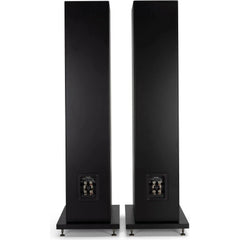
Two pairs of binding posts permit standard single-wire connection, bi-wiring, or bi-amplification. Leave the supplied terminal jumpers installed when using a conventional single pair of speaker cables.
High-Gloss Wood and Italian Leather
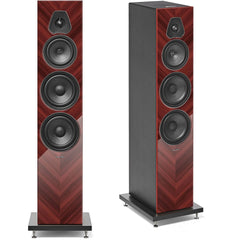
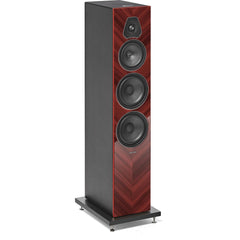
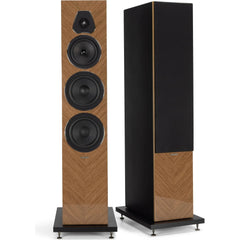
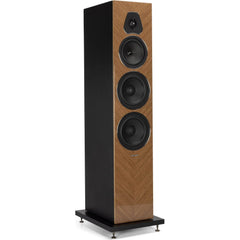
The Lumina V Amator is built at Sonus Faber’s factory in Vicenza, Italy. Its front baffle uses multilayer wood veneer arranged in a distinctive 45-degree pattern, with opposing grain directions meeting toward the center of the speaker.
Multiple layers of high-gloss lacquer enhance the depth and pattern of the veneer. The cabinet sides and top are wrapped in black leather, preserving one of Sonus Faber’s most recognizable design elements.
Available finishes include:
- Red High Gloss multilayer wood with black leather
- Wenge High Gloss multilayer wood with black leather
- Walnut High Gloss multilayer wood with black leather
Natural variations in woodgrain are expected and help make each pair visually distinctive. Avoid prolonged direct sunlight, excessive heat, and high humidity to help preserve the lacquer, veneer, and leather surfaces.
Lumina V Amator vs. Lumina V
The standard Lumina V and Lumina V Amator share the same basic cabinet dimensions, driver configuration, 38Hz–24kHz rated response, 89dB sensitivity, 4-ohm nominal impedance, and recommended amplifier range.
The principal differences are the Amator’s revised crossover and exclusive high-gloss veneers. Its upper crossover point is 2,850Hz rather than the standard model’s 2,600Hz, and its network incorporates crossover solutions influenced by the Amati G5 and Guarneri G5.
Choose the standard Lumina V when overall value is the priority and the traditional Walnut, Wenge, or Piano Black finishes are preferred. Choose the Lumina V Amator when the upgraded crossover, high-gloss finish, and more exclusive presentation justify the additional investment.
Stereo and Home Theater Applications
The Lumina V Amator has the bandwidth, bass output, and dynamic capability to anchor a serious two-channel music system. It is well suited to vinyl, high-resolution streaming, CD playback, and other quality source components.
It can also serve as the front left and right channels of a Lumina home theater. Pairing the speakers with a matching Lumina center channel helps maintain consistent tonal character across dialogue, music, and front-stage effects.
A powered subwoofer remains recommended for home theater systems where substantial output below 40Hz and dedicated low-frequency effects are priorities.
Who Should Choose the Lumina V Amator?
The Lumina V Amator is particularly well suited for listeners who want:
- A full-range floorstanding speaker for a medium or larger room
- Rich bass and an open, expressive midrange
- A refined alternative to the standard Lumina V
- A true three-way speaker with a dedicated midrange driver
- A broad and precisely organized stereo soundstage
- Flexible placement from a down-firing reflex port
- High-gloss real wood and black leather finishes
- A speaker built at Sonus Faber’s Vicenza, Italy facility
- A primary loudspeaker for both serious stereo and home theater use
Sonus Faber Lumina V Amator Specifications
| System | Three-way vented floorstanding loudspeaker |
|---|---|
| Tweeter | 29mm high-definition D.A.D. soft-dome driver |
| Midrange | 150mm paper and natural-fiber cone driver |
| Woofers | Two 165mm drivers with sandwich-construction diaphragms |
| Crossover Frequencies | 260Hz and 2,850Hz |
| Frequency Response | 38Hz–24,000Hz |
| Sensitivity | 89dB SPL at 2.83V/1m |
| Nominal Impedance | 4 ohms |
| Recommended Amplifier Power | 50–300 watts per channel, undistorted signal |
| Reflex Port | Down-firing through the speaker base |
| Connections | Four binding posts for single wiring, bi-wiring, or bi-amplification |
| Decoupling System | Iron spikes |
| Dimensions | 41.3 × 11 × 14.7 inches each |
| Weight | 49.6 pounds each |
| Available Finishes | Red High Gloss, Wenge High Gloss, and Walnut High Gloss |
| Cabinet Materials | High-gloss multilayer wood front panel with black leather covering |
| Country of Manufacture | Italy |
| Quantity | One stereo pair |
Purchase from an Authorized Sonus Faber Dealer
Audio Exchange is an authorized Sonus Faber dealer serving Richmond, Virginia, and customers throughout the United States. Contact us for help comparing the Lumina V Amator with the standard Lumina V, selecting suitable amplification, adding a subwoofer, or planning a complete Sonus Faber stereo or home theater system.
Explore the Sonus Faber Lumina collection.
Explore all Sonus Faber speakers available from Audio Exchange.


