

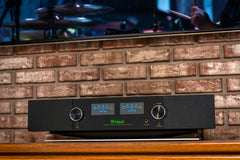
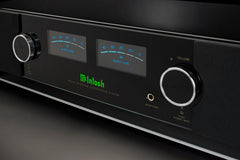

A complete McIntosh stereo system in one enclosure
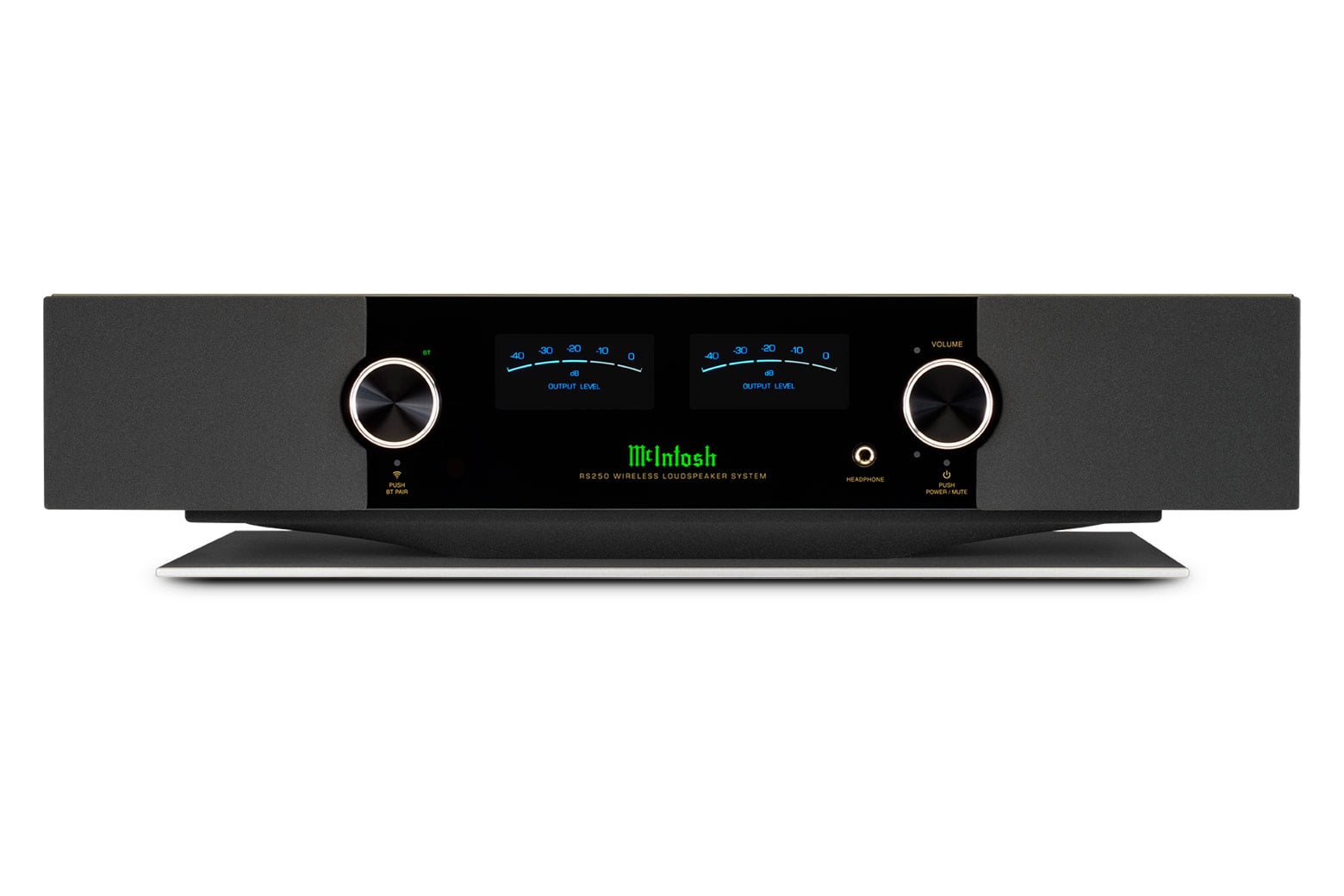
The McIntosh RS250 Wireless Loudspeaker System combines a network streamer, 650 watts of internal amplification, a true two-channel loudspeaker array, and connections for television, vinyl, digital, and analog sources in one compact component. It is designed for listeners who want McIntosh sound and styling without assembling a separate streamer, preamplifier, power amplifier, and pair of loudspeakers.
The RS250 can function as a primary music system in a living room, office, bedroom, apartment, or den. It can stream directly from popular services, connect to a television through HDMI ARC, accept a moving-magnet turntable, play a digital source through optical, and feed a powered subwoofer when deeper bass or higher output is desired.
RS250 highlights
- Complete two-channel wireless loudspeaker system with 650 watts of total internal power
- 400 watts assigned to the tweeter and midrange section and 250 watts assigned to the woofers
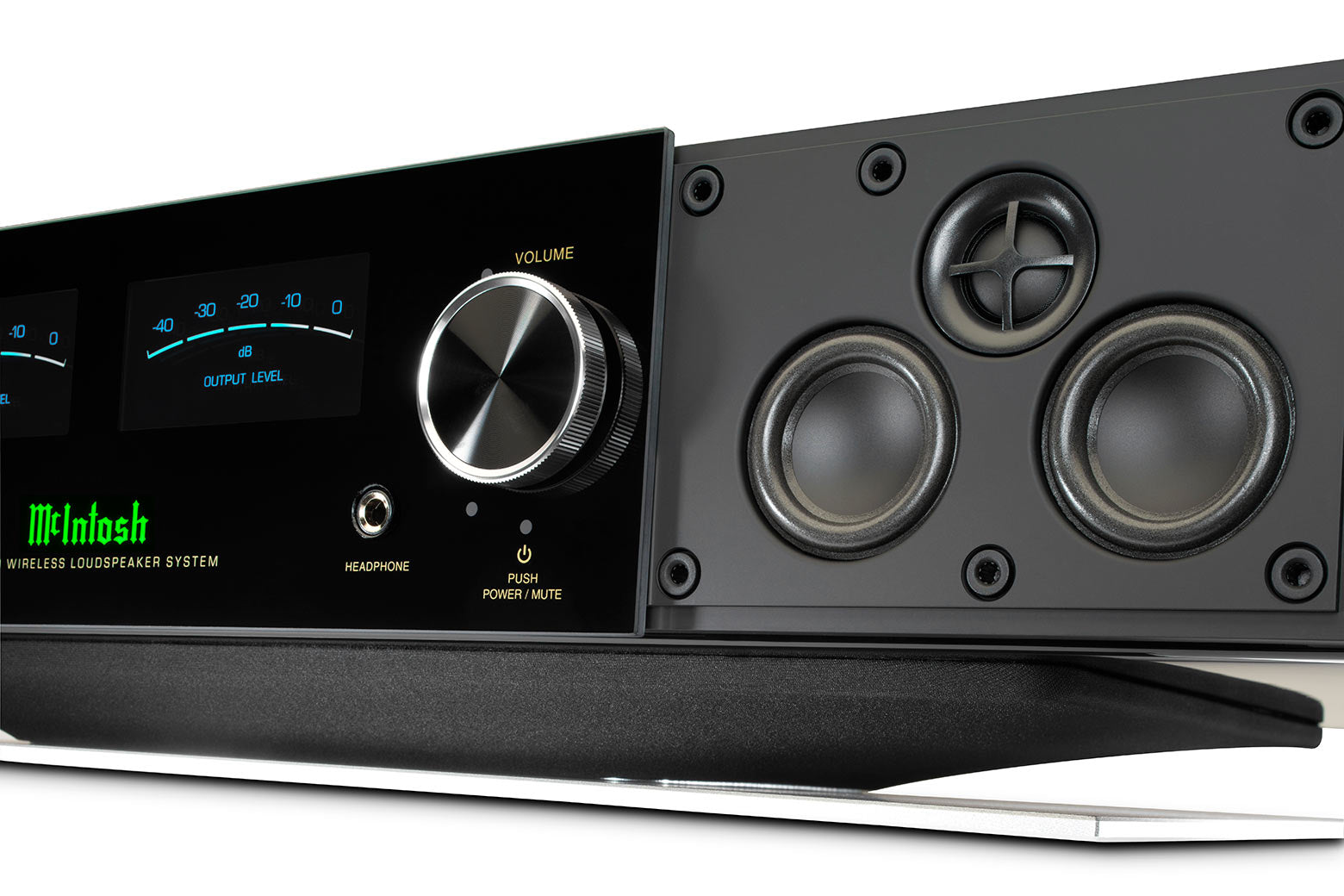
- Two tweeters, four midrange drivers, and two long-throw woofers
- Apple AirPlay 2, Chromecast, Spotify Connect, TIDAL Connect, Bluetooth 5.0, and Roon Ready
- Compatible network playback up to 24-bit/192kHz
- HDMI ARC and optical inputs for improved television sound
- Dedicated moving-magnet phono input for a compatible turntable
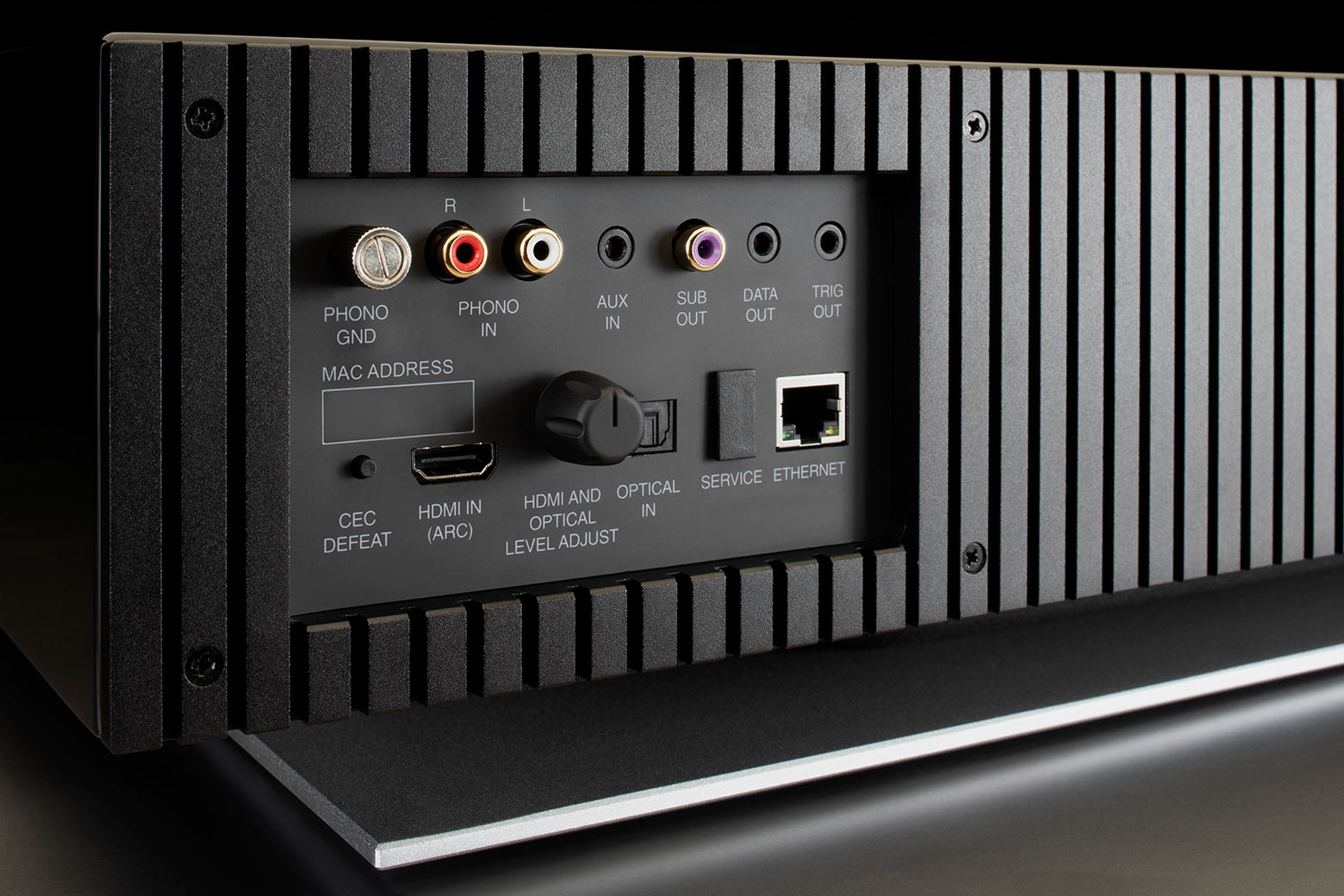
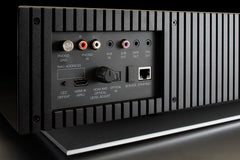
- 3.5mm auxiliary input, wired Ethernet, headphone output, and subwoofer output
- Adjustable bass control for room and placement matching
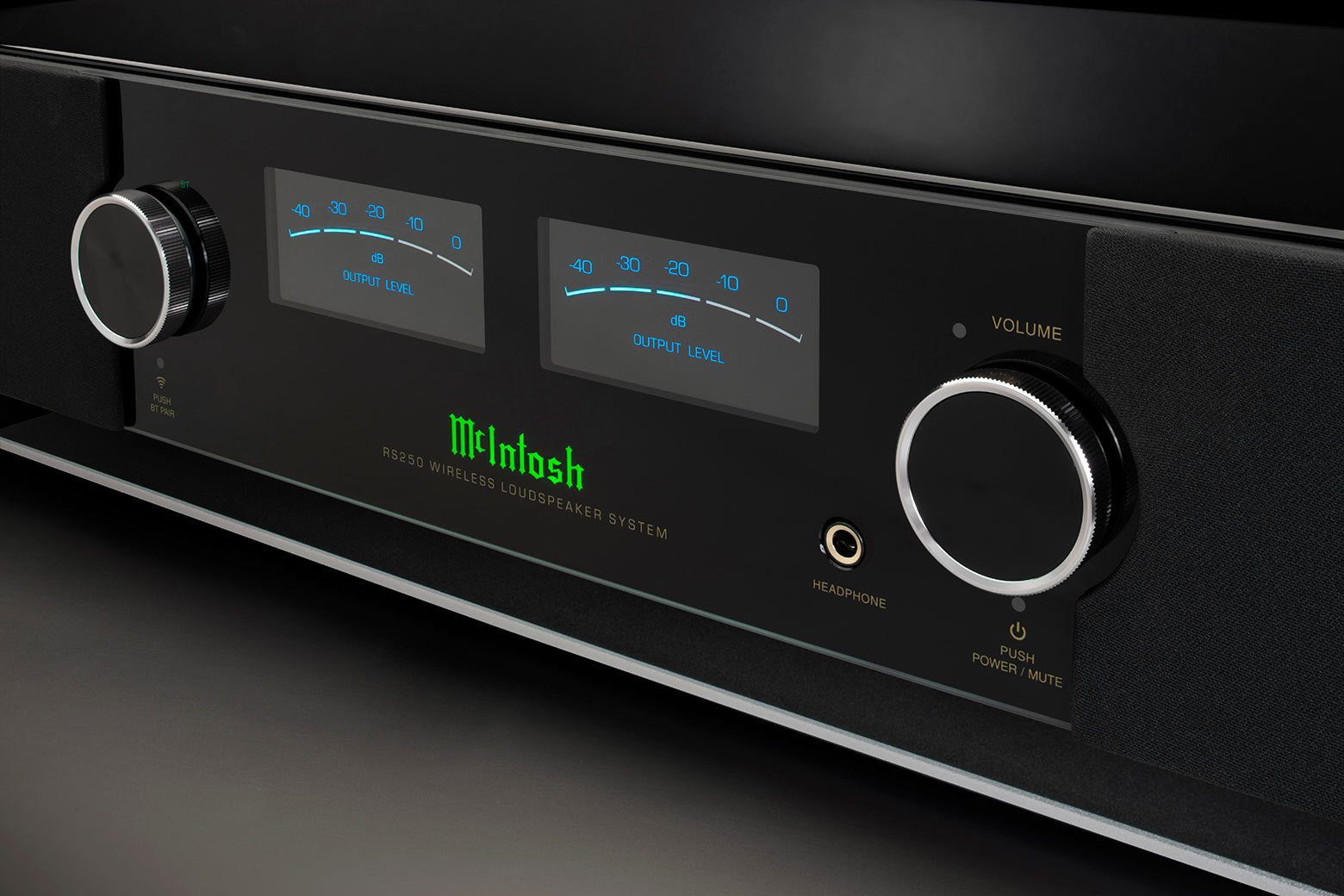
- Dual illuminated digital output meters and traditional McIntosh glass-front styling
- Three-year McIntosh limited warranty
True stereo reproduction from a single chassis
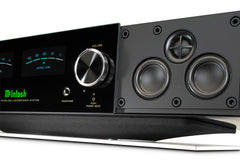
Unlike the mono RS150, the RS250 contains separate left and right channels. Its front-firing driver array uses two 20mm fluid-filled titanium-dome tweeters and four 50mm inverted-dome titanium midrange drivers. Two 4 x 6-inch long-throw woofers fire downward into the space above the base plate, allowing the enclosure to remain relatively low while still producing substantial bass output.
The internal amplifier system supplies 400 watts to the midrange and tweeter section and 250 watts to the woofers. Crossover points at 275Hz and 4,000Hz divide the frequency range among the three driver groups. The woofer enclosure was reengineered to reduce distortion, while the rear bass control allows low-frequency output to be adjusted for the room, furniture, and distance from nearby walls.
Wireless streaming without a proprietary control app
The RS250 is built around direct casting and service integration. Spotify Connect and TIDAL Connect let listeners choose the RS250 from within their familiar streaming apps. AirPlay 2 serves Apple devices, Chromecast works with compatible apps and platforms, and Roon users can select the RS250 as a Roon Ready endpoint.
Bluetooth 5.0 is included for quick direct playback and supports AAC, aptX HD, and aptX Low Latency with compatible source devices. For network streaming, the system supports dual-band Wi-Fi and wired Ethernet. Compatible high-resolution files can be streamed at up to 24-bit/192kHz, while TIDAL HiFi Lossless Quality playback is supported up to 1411 Kbps.
Use the RS250 with a television instead of a conventional soundbar
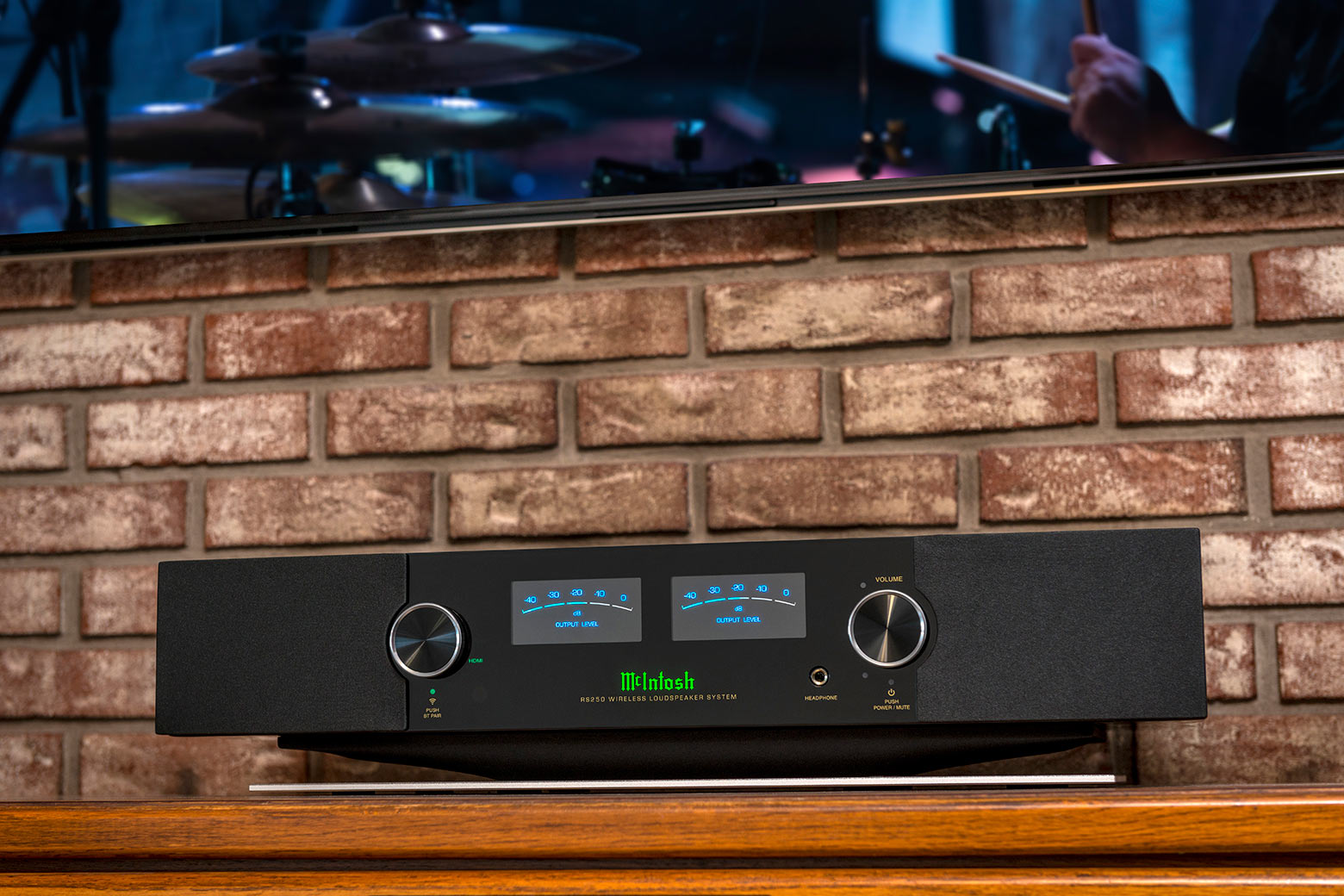
Searches for a “McIntosh soundbar” often lead to the RS250 because it can occupy a similar position beneath or near a television while providing a more music-focused stereo architecture. Its audio-only HDMI ARC input allows a compatible television to send sound back through the same HDMI connection used for ARC. An optical input is available for televisions that do not support ARC or for other digital components.
The RS250 is not a multichannel surround processor and does not decode a full home-theater speaker system. It is better understood as a premium two-channel television and music solution: one chassis, real left and right channels, substantial internal power, and the ability to serve both everyday television viewing and serious music listening.
Connect a turntable, digital source, headphones, or subwoofer
A dedicated moving-magnet phono input allows a compatible turntable to connect directly without an external phono preamplifier. The optical input can accommodate a CD player, television, or other digital source, while the 3.5mm auxiliary input accepts a broad range of analog devices.
A front-panel 1/4-inch headphone output supports private listening. The wired subwoofer output allows the RS250 to be expanded with a powered subwoofer when the room, listening level, or program material calls for greater low-frequency extension. This combination of inputs and outputs makes the RS250 substantially more flexible than a streaming-only wireless speaker.
Designed for practical placement
The RS250 measures 24-13/16 inches wide, 5-3/4 inches high, and 12-5/8 inches deep. Its low profile makes it suitable for a console, credenza, substantial shelf, desk, or furniture below many televisions. Because the woofers fire downward and the unit weighs 29.5 pounds, it should be placed on a stable surface with the area beneath and around the base left unobstructed.
The front panel uses high-gloss black glass, illuminated McIntosh branding, and two fast-responding digital output meters. These LED meters use signal-processing circuits based on McIntosh's familiar analog meter technology, translating the audio signal into curved, moving displays rather than simple decorative lights.
RS250 compared with the RS150
The McIntosh RS150 Wireless Loudspeaker is the smaller, mono option for a secondary room or compact listening area. The RS250 is the more complete system for listeners who want true stereo, substantially greater power, television integration, a phono input, optical and auxiliary connections, headphones, and the option to add a subwoofer.
Both models support the same core casting platforms and can be controlled from compatible streaming apps without a dedicated McIntosh application. The choice is therefore less about software and more about room size, stereo presentation, source requirements, and whether the speaker will serve as a casual secondary system or a primary entertainment component.
Technical specifications
| System type | Self-powered two-channel wireless loudspeaker system |
|---|---|
| Power output | 650 watts total: 400 watts to tweeters/midranges and 250 watts to woofers |
| Tweeters | Two 20mm fluid-filled titanium-dome drivers |
| Midranges | Four 50mm inverted-dome titanium drivers |
| Woofers | Two 4 x 6-inch long-throw drivers |
| Frequency response | 40Hz–20kHz |
| Crossover frequencies | 275Hz and 4,000Hz |
| Streaming | AirPlay 2, Chromecast, Spotify Connect, TIDAL Connect, Bluetooth 5.0, and Roon Ready |
| Maximum network resolution | Up to 24-bit/192kHz with compatible files and services |
| Inputs | HDMI ARC, optical, moving-magnet phono, 3.5mm auxiliary, Ethernet, Wi-Fi, and Bluetooth |
| Outputs | One powered-subwoofer output and one 1/4-inch headphone output |
| Finish | High-gloss black with black knit-cloth grilles |
| Dimensions | 24-13/16 W x 5-3/4 H x 12-5/8 D inches |
| Weight | 29.5 lb |
Frequently asked questions
Is the McIntosh RS250 a soundbar?
It can improve television sound through HDMI ARC or optical and may occupy a similar location, but it is a self-contained two-channel music system rather than a conventional multichannel soundbar.
Can I connect a turntable directly?
Yes, provided the turntable uses a compatible moving-magnet cartridge or otherwise supplies an appropriate moving-magnet-level signal. The RS250 includes a dedicated MM phono input.
Does the RS250 require a separate amplifier?
No. Its 650 watts of internal amplification power all eight drivers directly.
Can I add a subwoofer?
Yes. A wired subwoofer output is included for connection to a compatible powered subwoofer.
Does it require a McIntosh control app?
No. Playback is managed through compatible casting services, streaming apps, Bluetooth, Roon, and connected sources.
Is the RS250 sold as one unit?
Yes. The left and right channels, amplification, streaming electronics, and source connections are all contained in one RS250 enclosure.
System planning from Audio Exchange
Choosing between the RS250, a traditional stereo system, and a home-theater system depends on more than available space. Audio Exchange considers television connectivity, turntable compatibility, streaming habits, network reliability, room size, furniture placement, desired bass output, and future expansion. Browse the complete McIntosh speaker collection and McIntosh home-theater collection to compare the available approaches.
