

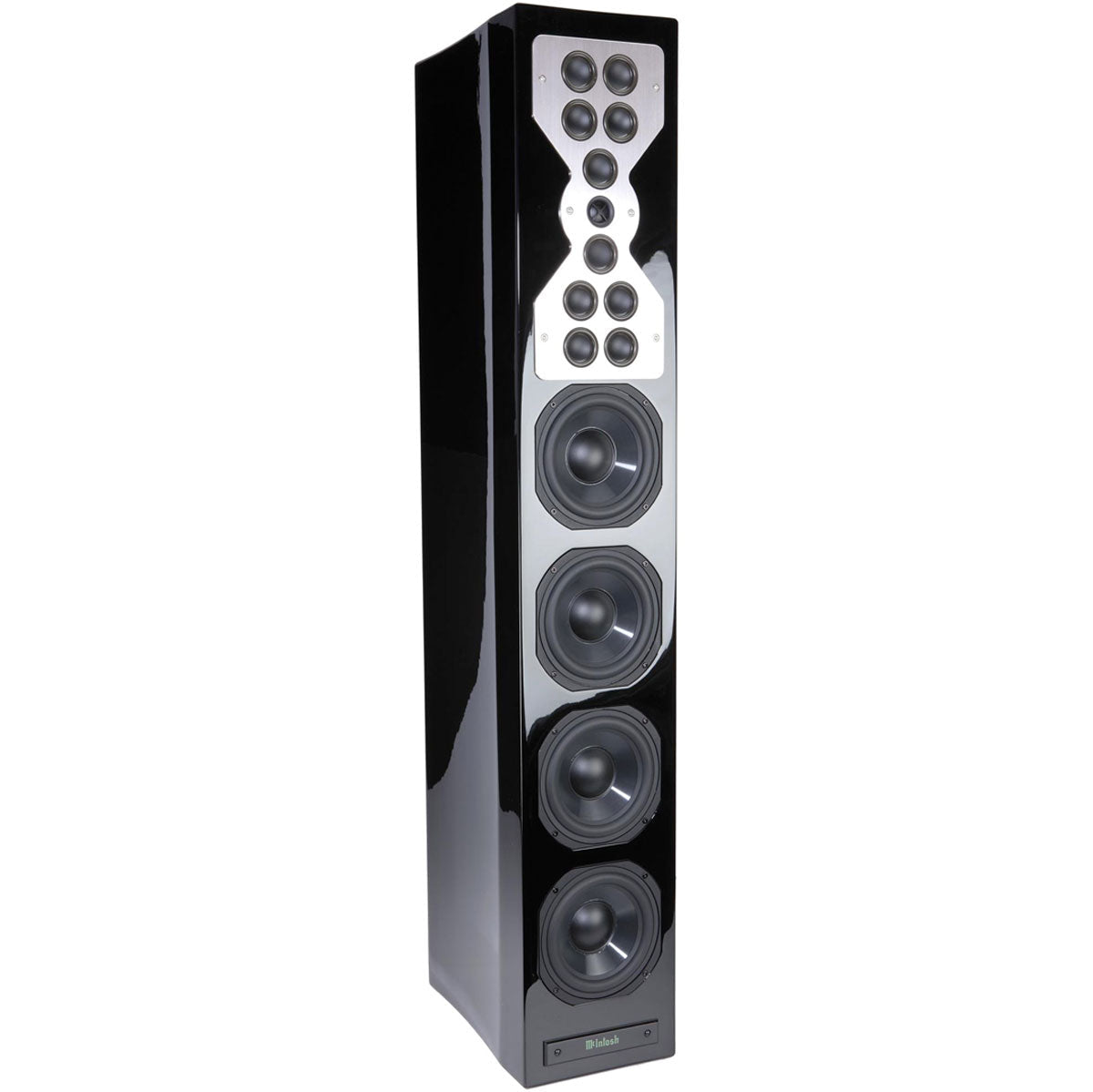
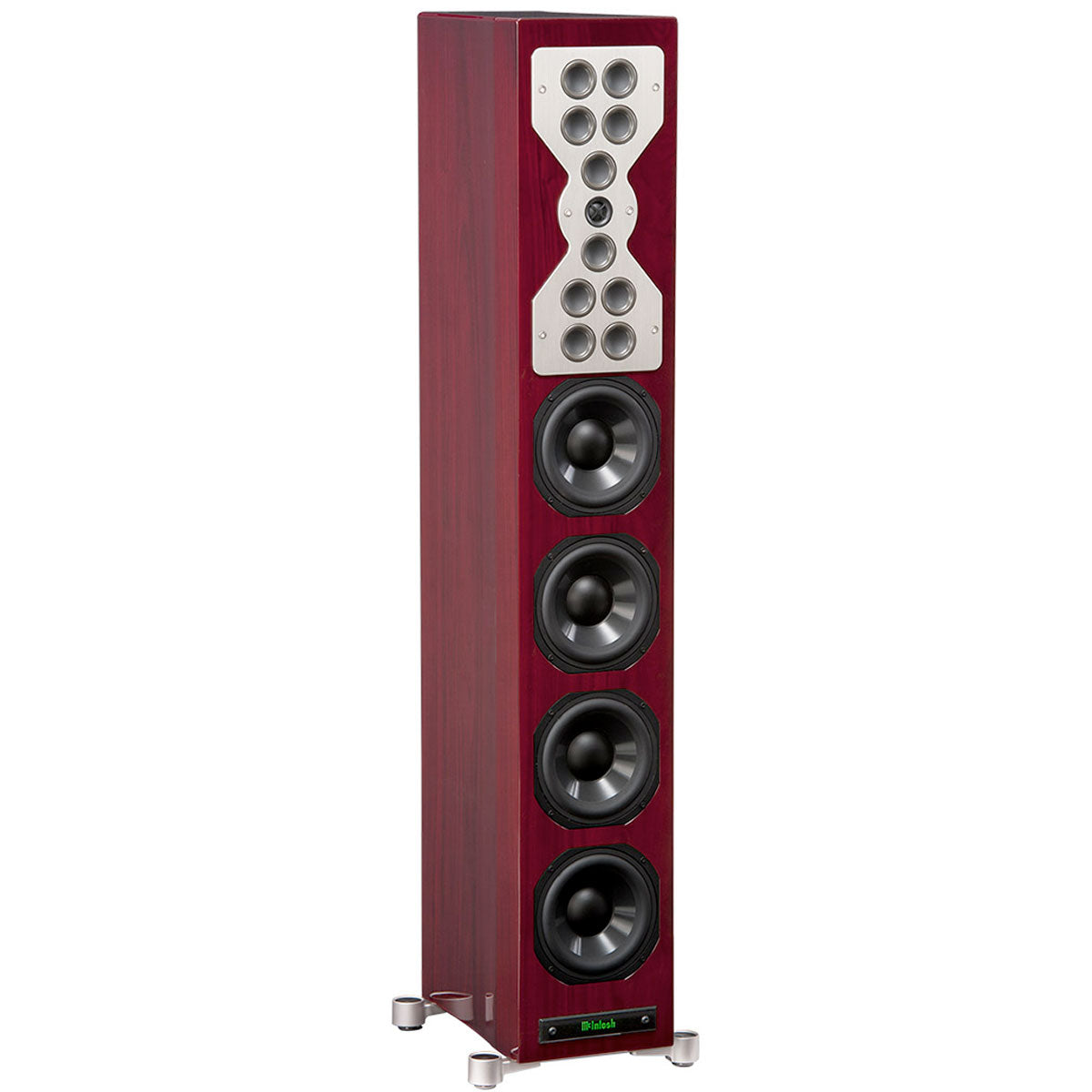

Full-range McIntosh performance in a slim floorstanding speaker
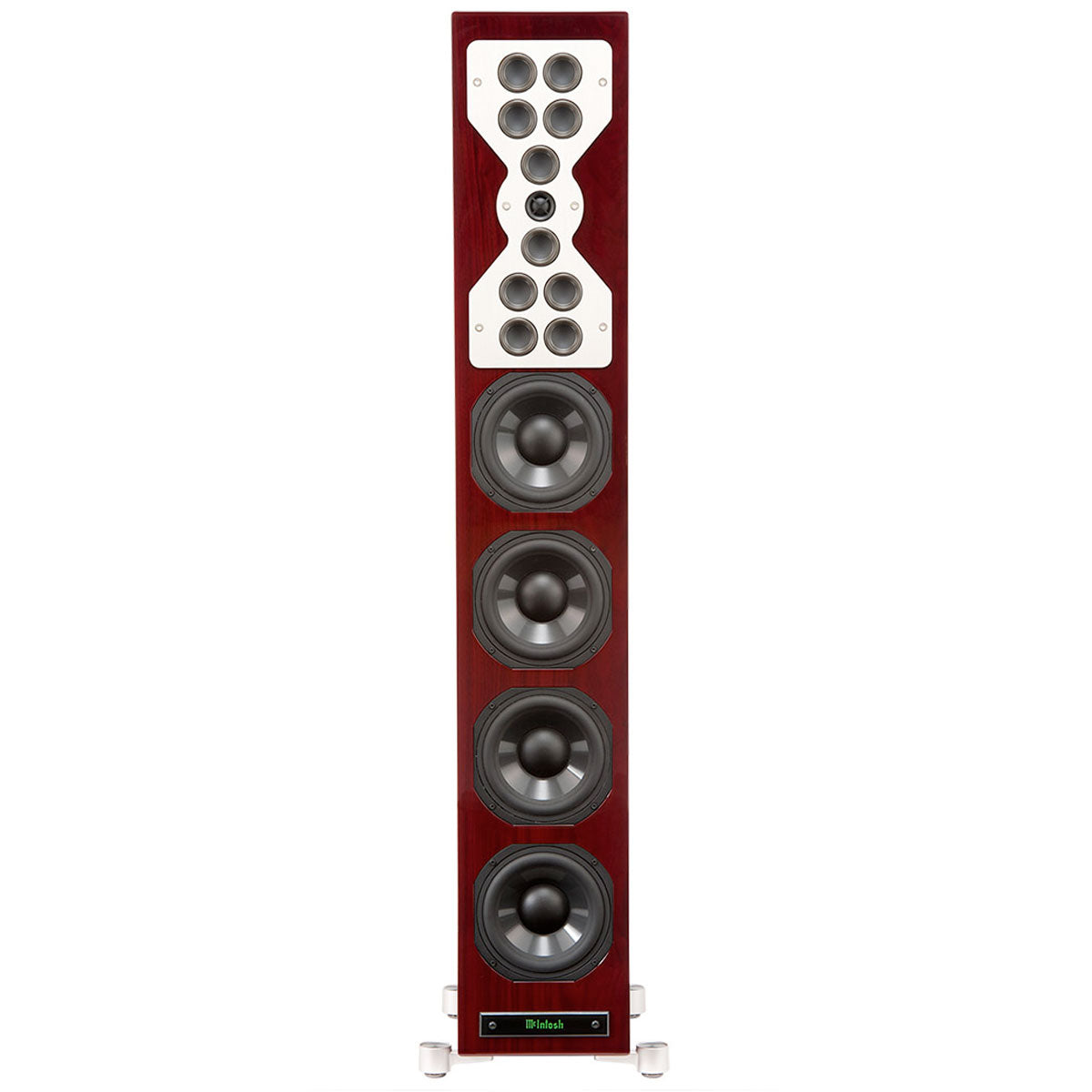
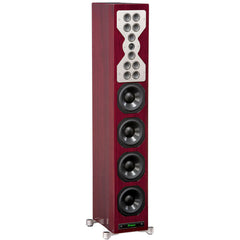
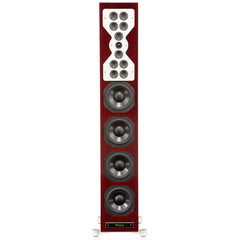
The McIntosh XR100 Floor Standing Loudspeaker is a ported 4-way tower built to deliver the scale, bass extension, and output of a much larger enclosure while occupying only 8 inches of floor width. Its unusually dense driver complement—four 6-inch woofers, ten 2-inch midrange and midrange-tweeter drivers, and one 3/4-inch tweeter—allows the XR100 to reproduce a broad frequency range with high power handling and wide listening coverage.
Designed for amplifiers rated from 75 to 600 watts, the XR100 can anchor a dedicated two-channel system or serve as the front left and right speakers in a high-performance McIntosh home theater. Its 8-ohm nominal impedance, 87dB sensitivity, and 30Hz-to-45kHz frequency response make amplifier quality, room size, placement, and listening level important parts of the system-matching process.
XR100 highlights
- Ported 4-way floorstanding loudspeaker
- Four 6-inch cast-frame LD/HP woofers
- Eight 2-inch inverted titanium-dome midrange drivers
- Two 2-inch inverted titanium-dome midrange-tweeters
- One 3/4-inch titanium-dome tweeter
- 30Hz–45kHz frequency response
- 75–600 watt recommended amplifier range
- 8-ohm nominal impedance and 87dB sensitivity
- Red Walnut and gloss Black finish options
- Magnetically attached acoustically transparent grille
- Gold-plated McIntosh Solid Cinch speaker binding posts
- Adjustable spikes and furniture-glide feet included
- Five-year McIntosh limited warranty
A 4-way driver system with dedicated frequency ranges
The XR100 divides the audible spectrum at 300Hz, 2kHz, and 8kHz. Four 6-inch woofers reproduce the low-frequency range. McIntosh's patented Low Distortion High Performance, or LD/HP, magnetic-circuit design is intended to reduce distortion while increasing power handling and efficiency. Using four woofers also provides substantial radiating area while allowing the cabinet to remain narrow.
Above the woofers, eight 2-inch inverted titanium-dome midrange drivers cover the 300Hz-to-2kHz region. Two additional 2-inch inverted titanium-dome midrange-tweeters operate from 2kHz to 8kHz, before the dedicated 3/4-inch titanium-dome tweeter takes over the highest frequencies. The closely spaced vertical arrangement helps distribute sound across a broader listening area than a conventional design with one large midrange driver.
This multi-driver approach also spreads the workload across several smaller diaphragms. Each group operates over a more limited frequency band, which allows the system to combine high output capability with the speed and dispersion advantages of compact midrange drivers.
Designed for both stereo and home theater
In a two-channel system, a pair of XR100 speakers can provide full-range reproduction without requiring a subwoofer in every room. Their rated extension to 30Hz gives them meaningful low-frequency capability for music, while the 45kHz upper-frequency specification accommodates high-resolution source material and wide-band system design.
For home theater, the XR100 can be used as the front left and right channels. The McIntosh home-theater collection provides processors and multichannel amplification for complete system planning, and McIntosh voices the LCR80 loudspeaker to match the XR100 for center-channel or other left-center-right applications. Matching the front soundstage helps voices and effects remain more consistent as they move across the screen.
Amplifier matching: more than choosing a wattage number
McIntosh specifies an appropriate amplifier range of 75 to 600 watts for the XR100. That broad range allows the speaker to work with many integrated amplifiers, stereo power amplifiers, and monoblock systems, but the best choice depends on the room and listening habits. A smaller room at moderate levels may not require the same reserve power as a large room, long listening distance, or music played near concert volume.
The XR100's four woofers and extensive midrange array can make use of clean power and dynamic headroom. Amplifier control is especially important in the bass, where multiple drivers are moving simultaneously. Audio Exchange evaluates the complete chain—including source, preamplifier, amplifier, cable length, room volume, and listening distance—rather than matching speakers by wattage alone. Browse McIntosh amplifiers to compare appropriate integrated, stereo, tube, and monoblock options.
Room placement and cabinet design
Although the XR100 is only 8 inches wide, it stands 51 inches tall and extends 18-1/2 inches deep including cables and connectors. The narrow front baffle reduces visual mass and makes the speaker easier to place beside furniture or a display, but its depth and rear-ported enclosure still require adequate room behind the cabinet.
Placement affects bass balance, imaging, and soundstage width. Moving the XR100 closer to walls or corners will generally increase low-frequency reinforcement, while pulling the speakers farther into the room can improve depth and reduce excessive bass in some spaces. Toe-in, spacing between the speakers, and distance from the listening position should be adjusted together rather than treated as separate decisions.
McIntosh includes adjustable spikes for carpet and furniture glides for hard floors. A level, stable cabinet helps the tall enclosure remain secure and keeps the drivers aligned as intended. The magnetically attached black knit-cloth grille can be removed without visible mounting hardware when the exposed driver array is preferred.
McIntosh construction and system integration
The XR100 is available in fine gloss Black and Red Walnut wood finishes. Gold-plated Solid Cinch binding posts provide a secure speaker-cable connection and resist corrosion. The front McIntosh logo can be illuminated when the speaker is configured with a compatible McIntosh system, adding a visual connection to the brand's amplifiers and source components.
At 68.5 pounds per speaker, the XR100 is substantial but more manageable than McIntosh's larger XRT line-array models. Its combination of a relatively small footprint, high power rating, and full-range response makes it a practical bridge between conventional tower speakers and McIntosh's much larger reference loudspeakers.
Technical specifications
| System type | Ported 4-way floorstanding loudspeaker |
|---|---|
| Recommended amplifier power | 75–600 watts |
| Nominal impedance | 8 ohms |
| Sensitivity | 87dB, 2.8V/1m |
| Frequency response | 30Hz–45kHz |
| Crossover frequencies | 300Hz, 2kHz, and 8kHz |
| Woofers | Four 6-inch cast-frame LD/HP poly-cone drivers |
| Midranges | Eight 2-inch inverted titanium-dome drivers |
| Midrange-tweeters | Two 2-inch inverted titanium-dome drivers |
| Tweeter | One 3/4-inch titanium-dome driver |
| Finishes | Gloss Black or Red Walnut |
| Grille | Magnetically attached black knit cloth |
| Dimensions | 8 W x 51 H x 18-1/2 D inches, including cables and connectors |
| Weight | 68.5 lb each |
Frequently asked questions
Is the McIntosh XR100 price for one speaker or a pair?
The listed price is for one XR100 loudspeaker. A conventional stereo system requires two speakers, so a pair should be ordered unless the XR100 is being used for a specialized single-channel application.
Does the XR100 need a subwoofer?
Not necessarily. Its rated response extends to 30Hz, which is sufficient for substantial full-range music reproduction in many rooms. A subwoofer may still be useful for the deepest movie effects, very large rooms, or listeners who want additional low-frequency output.
Can the XR100 be used in a home-theater system?
Yes. It is well suited to front left and right use. The McIntosh LCR80 is voiced to match the XR100 and can be used as a complementary center-channel speaker.
What amplifier power is appropriate?
McIntosh rates the XR100 for amplifiers from 75 to 600 watts. The correct choice depends on room size, listening distance, desired volume, program material, and the amplifier's ability to deliver clean power.
How far should the XR100 be placed from the wall?
There is no single distance that works in every room. Because the enclosure is ported, it should not be pressed tightly against the wall. Final placement should be adjusted by listening for bass balance, center imaging, soundstage depth, and consistency across the seating area.
What is the difference between XR100 and ML1 Mk II?
The XR100 is a tall, narrow, rear-ported tower with four woofers and a large vertical midrange array. The ML1 Mk II uses a wider vintage-style sealed cabinet, one 12-inch woofer, five total drivers, and included stands. Both handle up to 600 watts, but they differ significantly in appearance, enclosure design, driver layout, bass presentation, and room-placement requirements.
Choose the speaker around the room and system
The XR100's specifications make it versatile, but the best result comes from matching it to the room, amplifier, seating layout, and intended use. Audio Exchange can compare the XR100 with the ML1 Mk II and other models in the McIntosh speaker collection, while accounting for placement limits and the rest of the system before equipment is selected.
