



Reference-scale McIntosh line-array performance for serious listening rooms
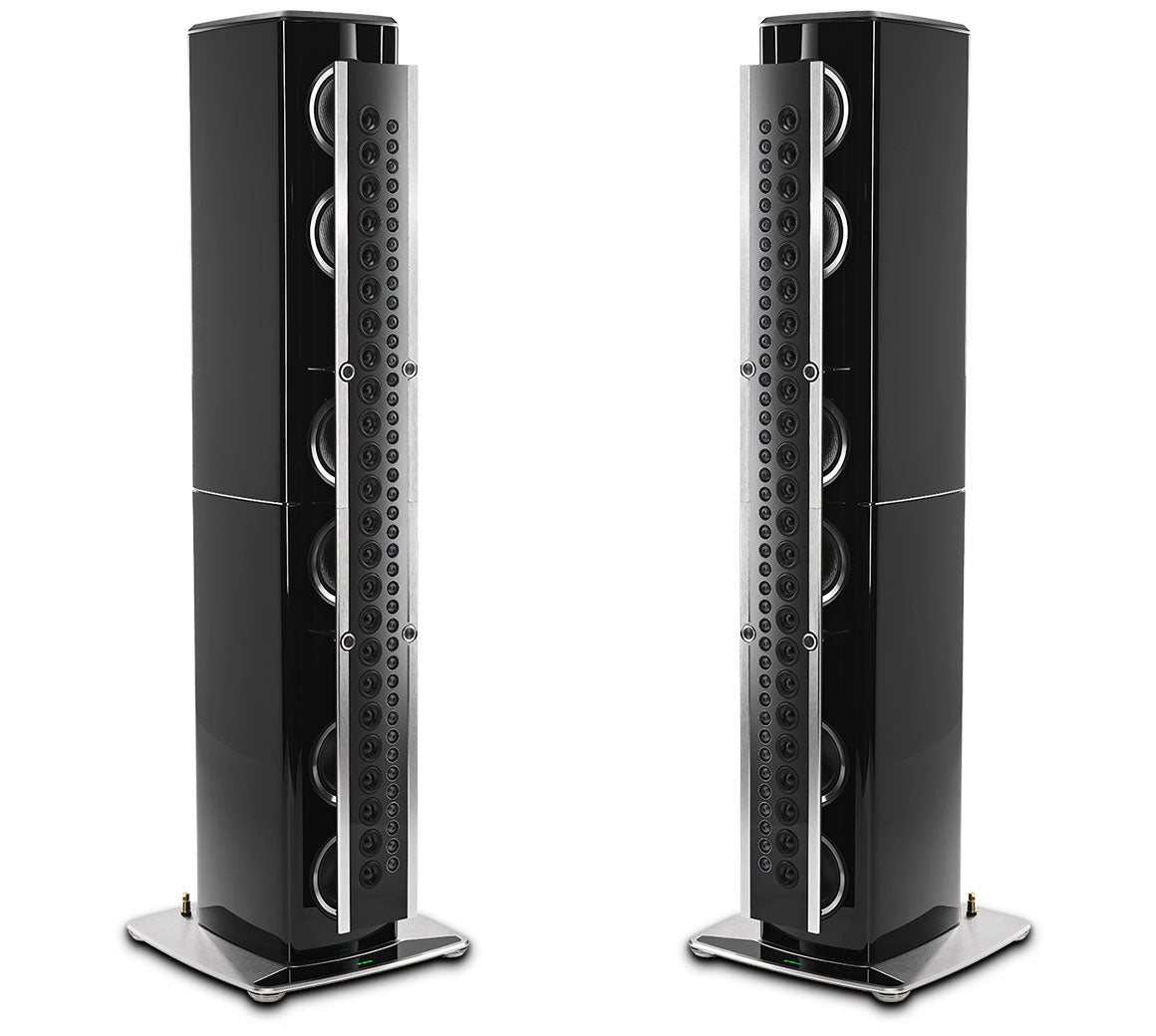
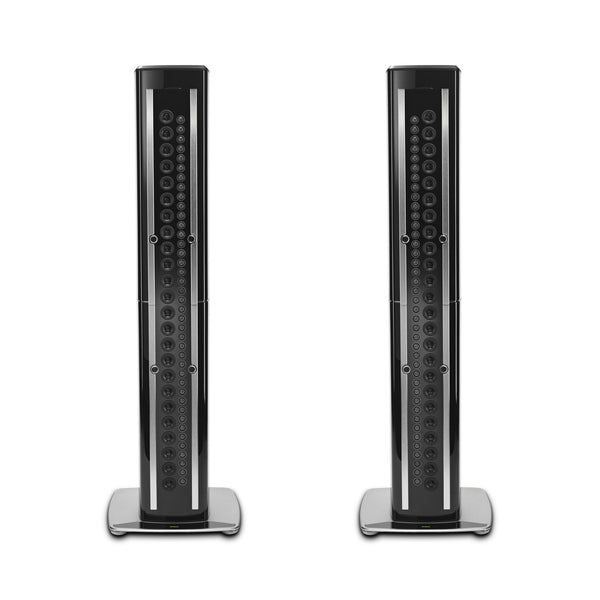
The McIntosh XRT1.1K Floor Standing Loudspeaker brings the wide dispersion, effortless output, and architectural presence of McIntosh's largest line-array systems into a design that is easier to accommodate than the flagship XRT2.1K. Each XRT1.1K is a full-range, ported 4-way loudspeaker with a 1,200-watt power rating, 70 individual drivers, and frequency response extending from 16Hz to 45kHz.
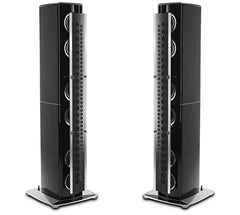
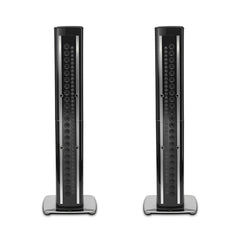
This is not a conventional tower speaker enlarged for visual impact. The XRT1.1K separates its low-frequency enclosure from a suspended vertical array of upper-midrange and high-frequency drivers. That arrangement is designed to produce a broad, even sound field across a larger seating area, reduce the dramatic level changes that can occur as listeners move closer to or farther from a traditional point-source speaker, and maintain convincing stereo imaging throughout a substantial room.
Price is per loudspeaker. The XRT1.1K is manufactured in dedicated left and right versions; a complete stereo system requires one of each. Contact Audio Exchange to confirm configuration, availability, delivery, and installation requirements.
XRT1.1K highlights
- Ported 4-way reference floorstanding loudspeaker
- McIntosh line-array design with 70 drivers per speaker
- Four 6.5-inch long-throw woofers
- Two 6.5-inch long-throw low-frequency midrange drivers
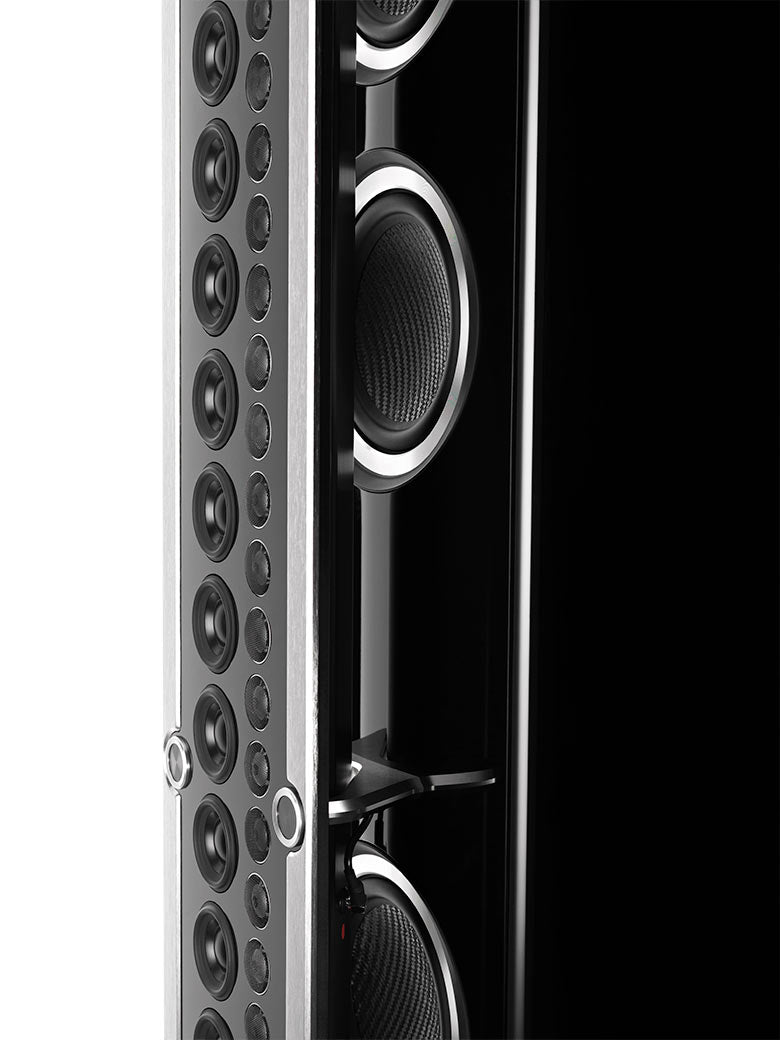
- Twenty-four 2-inch aluminum-magnesium upper-midrange drivers
- Forty 3/4-inch aluminum-magnesium dome tweeters
- 1,200-watt power rating
- 16Hz–45kHz frequency response
- 8-ohm nominal impedance and 89dB sensitivity
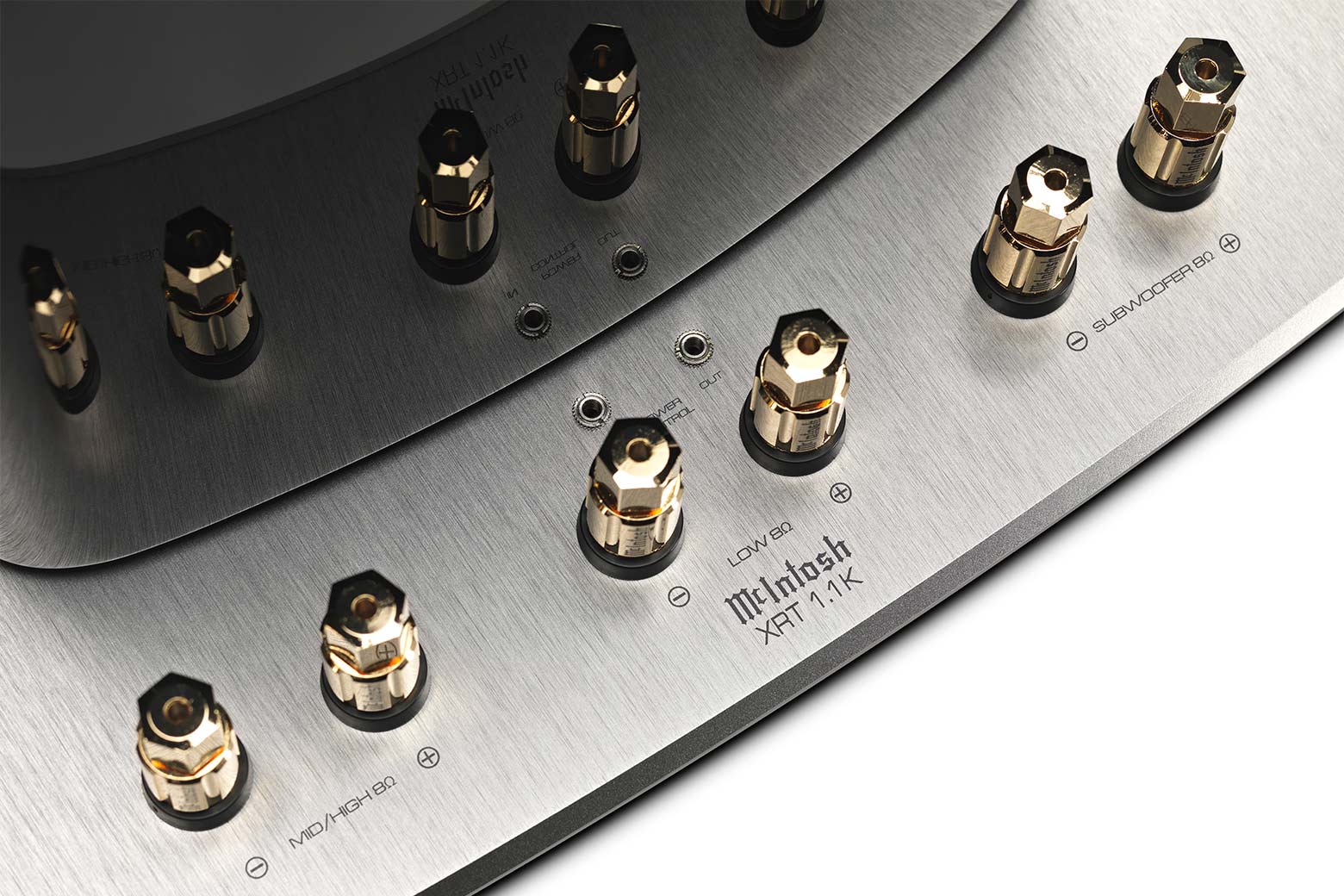
- Three separate connection sections for single amplification, tri-wiring, or tri-amplification
- Dedicated left and right loudspeaker construction
- Seven-layer Piano Black finish with brushed and black aluminum accents
- Magnetically attached black knit-cloth grilles
- Machined aluminum and glass base with four adjustable feet
- Illuminated McIntosh logo with compatible Power Control equipment
- Five-year McIntosh limited warranty
Why a line-array loudspeaker behaves differently
A conventional loudspeaker usually concentrates its midrange and high-frequency output into a relatively small group of drivers. The XRT1.1K instead distributes those frequencies across a tall vertical array containing 24 upper-midrange drivers and 40 tweeters. A listener seated relatively close to the speaker is directly aligned with only part of the array, while a listener farther away receives output from more of the driver column.
This geometry helps the XRT1.1K maintain a more consistent sound level and tonal balance over distance. It also creates a larger useful listening area than many high-end floorstanding speakers that are optimized around one tightly defined central seat. The result is particularly valuable in large two-channel rooms, multi-row listening spaces, and home theaters where several people should hear a stable front soundstage rather than one listener receiving the only ideal presentation.
The line-array design does not eliminate the need for careful setup. Speaker spacing, distance from the listening area, proximity to room boundaries, and symmetry within the room still affect imaging and bass response. It does, however, give the system a different dispersion pattern and a broader operating window than a conventional compact driver arrangement.
Seventy drivers divided across four frequency ranges
The XRT1.1K crossover divides the signal at 150Hz, 400Hz, and 2kHz. Four 6.5-inch woofers handle the deepest bass below the first crossover point. Two additional 6.5-inch drivers reproduce the low-frequency midrange, bridging the range between the woofer system and the suspended line array.
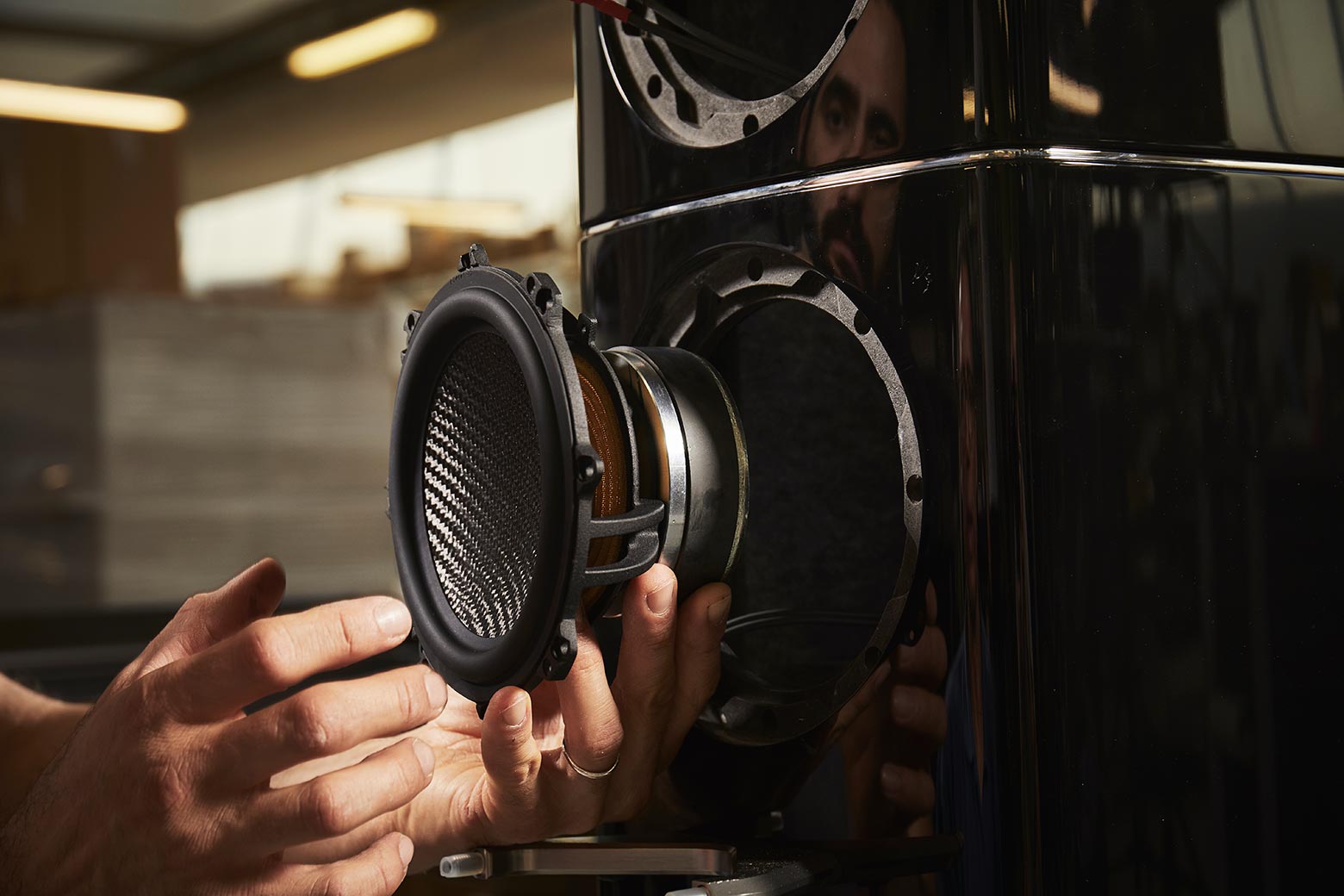
Both the woofers and low-frequency midranges use stiff, lightweight Nanocarbon Fiber/Nomex honeycomb diaphragms and long-throw motor systems. These drivers are housed in the large rear bass enclosure, where their surface area and excursion capability support the speaker's rated extension to 16Hz.
The suspended front array contains twenty-four 2-inch aluminum-magnesium dome upper-midrange drivers and forty 3/4-inch aluminum-magnesium dome tweeters. Their small diaphragms and large combined radiating area allow the system to reproduce the midrange and high frequencies at substantial output levels without relying on one driver to cover the entire room.
Deep bass without separating the speaker into a tower and subwoofer
A rated low-frequency extension of 16Hz places the XRT1.1K below the lowest fundamental frequency of most musical instruments and into the range normally associated with dedicated subwoofers. That does not mean every room will produce perfectly flat response to 16Hz, but it does mean the speaker was engineered as a genuinely full-range system rather than a main loudspeaker that assumes a separate subwoofer will handle the bottom octave.
The four woofers and two low-frequency midranges work within a rear-ported bass enclosure. Their long-throw design allows substantial air movement while the large cabinet provides the internal volume necessary for deep extension. For music-first systems, a properly positioned pair of XRT1.1K speakers may supply all the low-frequency output required. In a reference home theater, a dedicated McIntosh powered subwoofer may still be appropriate for additional low-frequency effects, room-mode management, or multi-subwoofer coverage.
Crossover components selected for high power and linearity
Handling up to 1,200 watts requires more than durable drivers. The crossover network uses low-loss capacitors and high-current inductors selected for linear behavior at elevated power levels. Each section is designed to maintain an even transition between the bass enclosure and line array without allowing the crossover components themselves to become a source of compression or distortion.
Self-resetting high-current PTC protection devices provide an additional measure of driver protection. They are not a substitute for properly matched amplification or reasonable system operation, but they help protect the loudspeaker if abnormal current conditions occur.
Single amplification, tri-wiring, or true tri-amplification
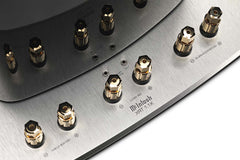
Three separate pairs of gold-plated McIntosh Solid Cinch binding posts are provided for the mid/high, low, and subwoofer-frequency sections. The XRT1.1K can be operated from one amplifier channel using the correct factory connection arrangement, or the sections can be separated for more advanced wiring and amplification systems.
Tri-wiring uses separate cable runs from one amplifier channel to the three loudspeaker input sections. Tri-amplification assigns separate amplifier channels to those sections. A properly engineered tri-amplified system can provide exceptional power reserve and control, but it also requires careful attention to amplifier gain, polarity, grounding, cable routing, and the connection instructions supplied by McIntosh.
McIntosh specifically identifies amplifiers such as its high-power monoblocks and dual-mono amplifier designs as natural system partners. Audio Exchange can plan the XRT1.1K around an existing system or develop a complete amplification architecture using the McIntosh amplifier collection.
Dedicated left and right speakers
The XRT1.1K is not physically interchangeable from one side of the room to the other. McIntosh manufactures dedicated left and right versions, and the line-array column and woofer enclosure are marked accordingly. The left speaker should be installed on the listener's left and the right speaker on the listener's right.
This orientation affects both assembly and final positioning. The line-array column must be attached to the matching left or right bass enclosure, and the connection cables must remain on the correct side. A stereo system should therefore be planned and ordered as a matched left/right pair even though the displayed price is per loudspeaker.
Placement requirements for a rear-ported reference loudspeaker
The XRT1.1K measures approximately 21-7/32 inches wide, 70-23/32 inches high, and 21-7/32 inches deep. Its footprint is nearly square, and its rear ports require substantially more breathing room than a slim conventional tower placed close to the front wall.
McIntosh's owner guidance uses approximately 37.7 inches as a starting minimum distance between the rear of the speaker and the wall behind it. The final distance should be adjusted around the room's bass behavior, listening position, and desired soundstage depth. Nearby side walls, large furniture, open doorways, and asymmetrical room boundaries can also influence the result.
The line array provides wide horizontal coverage, and McIntosh notes that aggressive toe-in should not normally be necessary. Initial setup should begin with the speakers facing forward, followed by careful adjustment based on center imaging, soundstage width, tonal balance, and consistency across the intended seating area.
Delivery, assembly, and floor support
Each XRT1.1K weighs 181 pounds and has a shipping weight of 319 pounds. The bass enclosure and line-array column are packed separately and assembled at the installation location. The process involves aligning the correct left or right array with its matching woofer cabinet, securing the structural mounting points, and connecting the internal array cables.
Professional delivery and installation are strongly recommended. Door widths, elevators, stairways, turning clearances, floor loading, packaging removal, and the final path into the listening room should be reviewed before the speakers arrive. The machined aluminum and glass base includes four adjustable feet so the enclosure can be leveled and placed in stable contact with the floor.
Seven-layer Piano Black construction
The bass cabinet is finished in seven layers of high-gloss Piano Black paint with brushed and black aluminum accents. The line array is suspended in front of the bass enclosure by steel supports inspired by modern skyscraper construction. Magnetic covers conceal the mounting hardware and resemble traditional McIntosh control knobs.
Black knit-cloth grilles with gloss trim attach magnetically and can be removed to expose the complete driver system. The base combines machined aluminum and glass, while the McIntosh logo can illuminate when connected to compatible components through Power Control.
Two-channel and reference home-theater applications
A matched pair of XRT1.1K loudspeakers can anchor a reference two-channel system with enough bandwidth and output capability for large rooms and demanding playback levels. Their wide dispersion also makes them suitable for systems intended to serve more than one listener rather than a single narrowly defined seat.
For home theater, the XRT1.1K can serve as the front left and right loudspeakers. McIntosh designed the XCS1.5K center channel to match the tonal character and line-array presentation of both the XRT1.1K and XRT2.1K. Visit the McIntosh home-theater collection for processors, multichannel amplification, and complete front-stage planning.
XRT1.1K compared with other McIntosh speakers
The McIntosh XR100 is a far narrower and lighter tower rated for amplifiers from 75 to 600 watts. It is easier to position in a conventional room and provides much of the wide-dispersion character associated with a vertical driver array, but it does not approach the XRT1.1K's scale, driver count, bass extension, or tri-amplification capability.
The McIntosh ML1 Mk II takes a different approach with a sealed vintage-style cabinet, one 12-inch woofer, and included stands. It is a substantial full-range loudspeaker, but the XRT1.1K is designed for larger rooms, much higher output, and a wider line-array presentation.
The larger XRT2.1K increases the system to 81 drivers, six 8-inch woofers, a 2,000-watt rating, and even greater cabinet height and weight. The XRT1.1K retains the core reference line-array architecture in a speaker that is 14 inches shorter and 173 pounds lighter per cabinet.
Technical specifications
| System type | Ported 4-way floorstanding line-array loudspeaker |
|---|---|
| Power rating | 1,200 watts |
| Nominal impedance | 8 ohms |
| Sensitivity | 89dB, 2.8V/1m |
| Frequency response | 16Hz–45kHz |
| Crossover frequencies | 150Hz, 400Hz, and 2kHz |
| Woofers | Four 6.5-inch Nanocarbon Fiber/Nomex honeycomb long-throw drivers |
| Low-frequency midranges | Two 6.5-inch Nanocarbon Fiber/Nomex honeycomb long-throw drivers |
| Upper-frequency midranges | Twenty-four 2-inch aluminum-magnesium dome drivers |
| Tweeters | Forty 3/4-inch aluminum-magnesium dome drivers |
| Total drivers | 70 per loudspeaker |
| Connections | Three pairs of gold-plated Solid Cinch binding posts for mid/high, low, and subwoofer-frequency sections |
| Wiring options | Single amplification, tri-wiring, or tri-amplification |
| Finish | Seven-layer Piano Black with brushed and black aluminum accents |
| Grilles | Magnetically attached black knit cloth with high-gloss trim |
| Dimensions | 21-7/32 W x 70-23/32 H x 21-7/32 D inches, including feet |
| Unit weight | 181 lb each |
| Shipping weight | 319 lb each |
| Warranty | Five-year McIntosh limited warranty |
Frequently asked questions
Is the listed XRT1.1K price for one speaker or a pair?
The listed price is for one XRT1.1K loudspeaker. A stereo system requires a dedicated left speaker and dedicated right speaker, making the current pair price $80,000 before delivery, installation, taxes, or system accessories.
Does the XRT1.1K include a built-in amplifier?
No. It is a passive loudspeaker and requires external amplification. Its three input sections allow it to be driven by one amplifier channel or incorporated into a more elaborate tri-amplified system.
Does it require three amplifiers per speaker?
No. The XRT1.1K can operate from one appropriate amplifier channel when connected according to McIntosh's instructions. Tri-amplification is an optional advanced configuration.
Does the XRT1.1K need a subwoofer?
Not necessarily. Its rated response reaches 16Hz, giving it deeper specified extension than many standalone subwoofers. A separate subwoofer may still be useful in home theater, for multi-subwoofer room coverage, or when additional low-frequency headroom is desired.
Can either cabinet be used as the left or right speaker?
No. The XRT1.1K has dedicated left and right versions. The correct model and line-array column must be installed on the corresponding side of the room.
How far should it be placed from the rear wall?
McIntosh's placement guidance gives approximately 37.7 inches as a starting minimum because of the rear ports. Final placement should be optimized in the actual room.
Should the speakers be toed in toward the listener?
McIntosh states that toe-in should generally not be necessary because of the line array's wide dispersion. The speakers should normally begin facing forward and then be adjusted only if room conditions and listening tests justify a change.
Can the XRT1.1K be used for home theater?
Yes. A pair can serve as the front left and right channels in a reference home theater. The McIntosh XCS1.5K center channel is designed to match the XRT1.1K's tonal and dispersion characteristics.
Plan the room, amplification, and installation before ordering
The XRT1.1K is a complete-room project rather than a speaker that should be selected from specifications alone. Audio Exchange can evaluate room dimensions, seating distance, amplifier architecture, electrical requirements, speaker-cable routing, delivery access, floor conditions, and home-theater integration before the system is ordered. Explore the complete McIntosh speaker collection or contact Audio Exchange to begin planning.
