

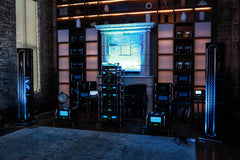

McIntosh’s full-scale reference line-array loudspeaker
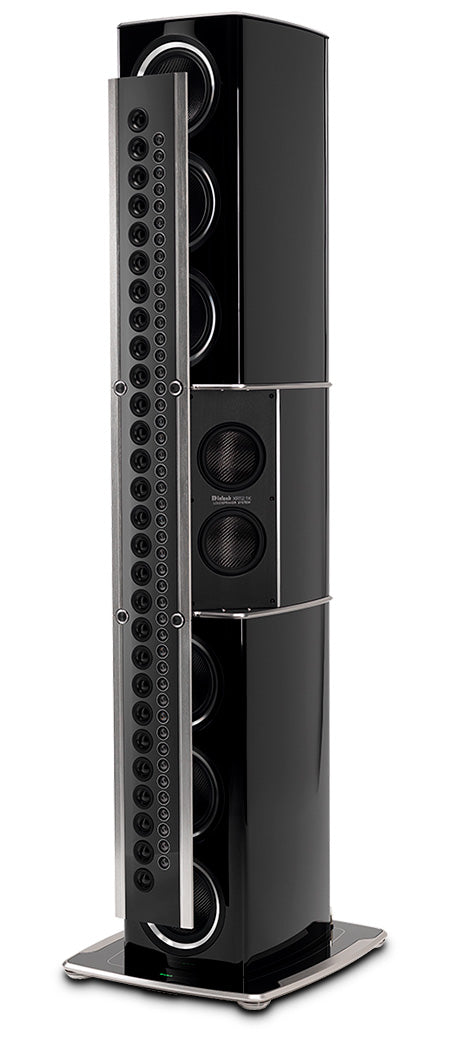
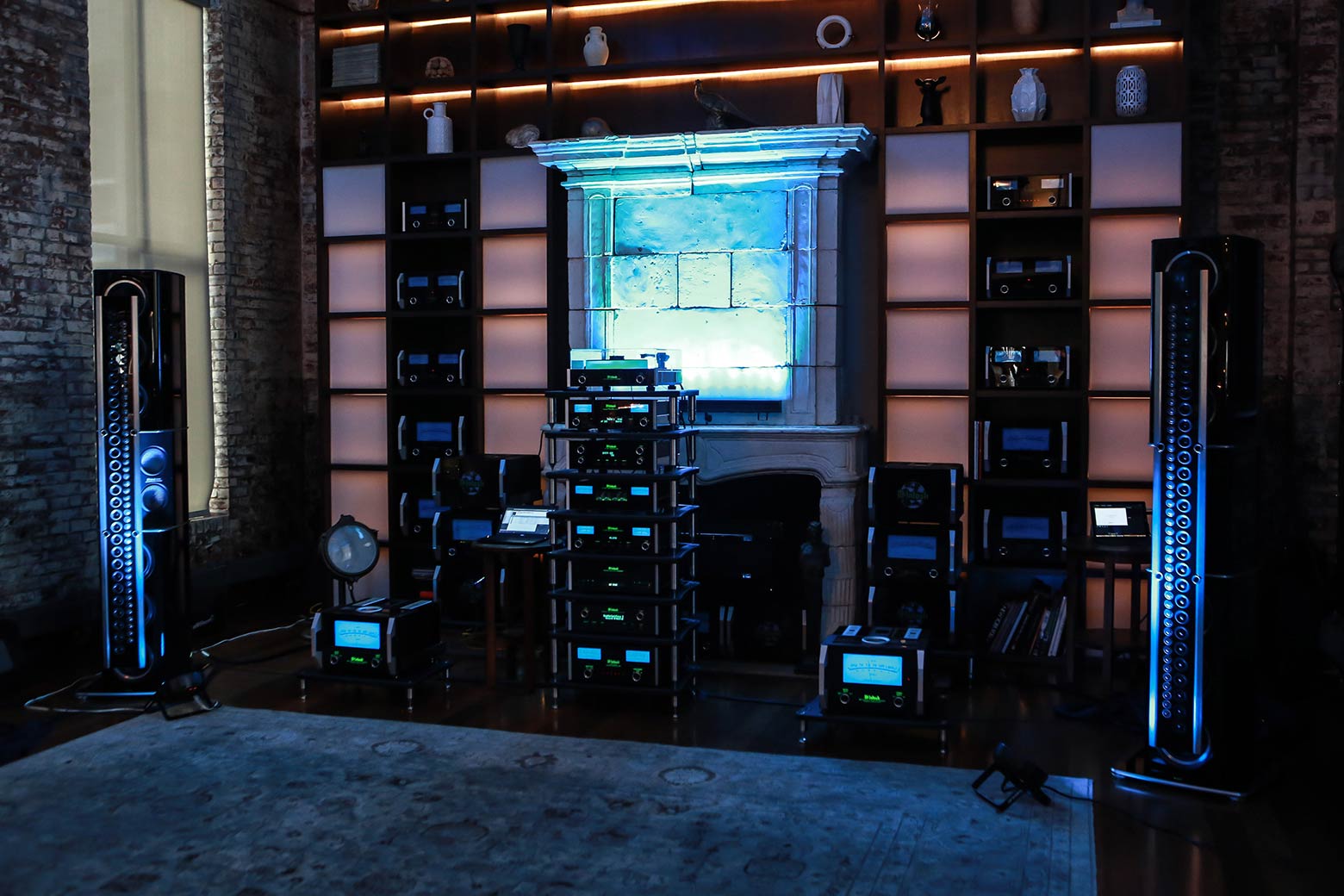
The McIntosh XRT2.1K Floor Standing Loudspeaker is the largest passive loudspeaker in the current McIntosh range. Standing approximately seven feet tall, each XRT2.1K combines a massive ported bass enclosure with a suspended vertical line array containing 73 upper-midrange and high-frequency drivers. The complete 4-way system uses 81 drivers, handles up to 2,000 watts, and extends from 12Hz to 45kHz.
The scale is extraordinary, but the XRT2.1K is designed to do more than play loudly. McIntosh’s line-array geometry distributes sound across a tall radiating surface to create broad horizontal coverage, a stable soundstage, and more consistent listening levels over distance. It is intended for large dedicated two-channel rooms and reference home theaters where effortless dynamics, full-range bass, and convincing imaging should extend beyond one narrowly defined listening seat.
Price is per loudspeaker. The XRT2.1K is manufactured in dedicated left and right versions; a complete stereo system requires one of each. Contact Audio Exchange to confirm configuration, availability, delivery access, installation requirements, and system design before ordering.
XRT2.1K highlights
- McIntosh reference ported 4-way floorstanding loudspeaker
- 81 individual drivers per cabinet
- Six 8-inch long-throw woofers
- Two 6.5-inch long-throw low-frequency midrange drivers
- Twenty-eight 2-inch aluminum-magnesium upper-midrange drivers
- Forty-five 3/4-inch aluminum-magnesium dome tweeters
- 2,000-watt power rating
- 12Hz–45kHz frequency response
- 8-ohm nominal impedance and 90dB sensitivity
- Three connection sections for single amplification, tri-wiring, or tri-amplification
- Dedicated left and right loudspeaker construction
- Seven-layer Piano Black finish with brushed and black aluminum accents
- Magnetically attached black knit-cloth grilles
- Machined aluminum and glass pedestal with four adjustable feet
- Illuminated McIntosh logo with compatible Power Control equipment
- Five-year McIntosh limited warranty
Why the XRT2.1K line array sounds different
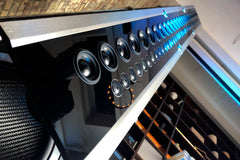
Most conventional loudspeakers concentrate the midrange and treble into a small group of drivers near ear level. The XRT2.1K distributes those frequencies across a nearly floor-to-ceiling column containing 28 upper-midrange drivers and 45 tweeters. The result is a cylindrical-wave behavior that differs from the spherical dispersion of a traditional point-source speaker.
Listeners positioned closer to the speaker are directly aligned with only part of the array, while listeners farther away receive output from more of the column. This helps reduce the dramatic changes in level and tonal balance that can occur as people move through a large room. It also broadens the useful listening area while maintaining strong stereo separation and image stability.
The line-array concept does not remove the need for careful setup. Speaker spacing, listening distance, room symmetry, nearby boundaries, and acoustic treatment remain important. What it provides is a fundamentally different dispersion pattern, with wide horizontal coverage and reduced floor and ceiling interaction compared with a conventional tall tower using only a few midrange and high-frequency drivers.
Eighty-one drivers divided across four frequency ranges
The XRT2.1K crossover divides the signal at 150Hz, 450Hz, and 2.1kHz. Six 8-inch woofers reproduce the lowest frequencies. Two 6.5-inch drivers handle the low-frequency midrange, bridging the transition from the bass system to the suspended upper-frequency array.
The woofer and low-frequency midrange diaphragms use stiff, lightweight Nanocarbon Fiber/Nomex honeycomb construction with long-throw motor systems. Their combined radiating area and excursion capability allow the speaker to move the volume of air required for deep bass while maintaining control at demanding playback levels.
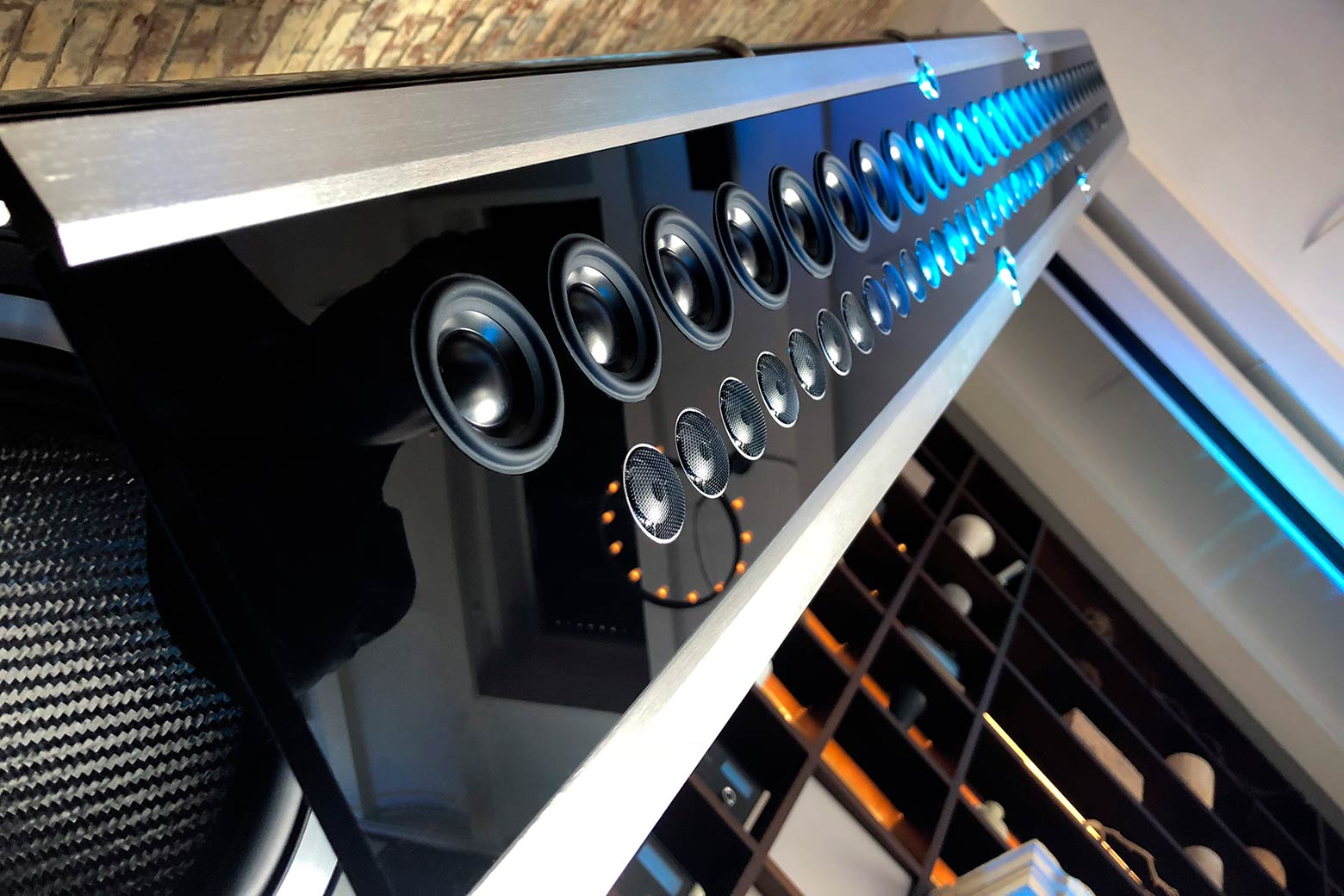
The front array contains twenty-eight 2-inch aluminum-magnesium upper-midrange drivers and forty-five 3/4-inch aluminum-magnesium dome tweeters. Neodymium magnets and the array’s large combined surface area allow the system to produce substantial output without asking one or two small drivers to cover an entire large listening room.
Full-range extension to 12Hz
A rated low-frequency response of 12Hz places the XRT2.1K well below the lowest fundamental frequencies produced by most musical instruments. The system is engineered as a genuinely full-range loudspeaker rather than a main speaker that assumes a separate subwoofer will reproduce the lowest octave.
The six woofers and two low-frequency midranges are distributed through the reinforced bass enclosure. Multiple internal braces create a rigid, damped structure, while the ported design supports the exceptional low-frequency extension. Room dimensions and placement will determine the exact in-room response, so professional measurement and position optimization remain essential.
For a music-first system, a properly positioned XRT2.1K pair may provide all of the bass extension and output required. In a reference home theater, dedicated subwoofers can still be useful for independent low-frequency-effects routing, multiple-subwoofer room-mode control, or additional bass coverage across several seating rows.
Crossover engineering for 2,000-watt operation
High power capability requires more than durable drivers. The XRT2.1K crossover network uses low-loss capacitors, high-current inductors, specialized metallic cores, and high-power resistors with integrated heat sinking. The components are selected to remain linear under substantial current so the crossover does not become a source of compression or distortion as playback levels rise.
Self-resetting high-current PTC protection devices provide an additional measure of driver protection. If abnormal overdrive activates a protection section, it automatically resets after the volume is reduced. This protection is not a substitute for correct amplifier matching or responsible operation, but it adds resilience to a loudspeaker designed for unusually high dynamic demands.
Single amplification, tri-wiring, or true tri-amplification
Three separate pairs of gold-plated McIntosh Solid Cinch binding posts are provided for the mid/high, low, and subwoofer-frequency sections. Factory jumper cables allow the XRT2.1K to operate from one suitable amplifier channel, while the separate inputs support more advanced system architectures.
Tri-wiring uses three separate speaker-cable runs from one amplifier channel to the three input sections. Tri-amplification assigns separate amplifier channels to the mid/high, low, and subwoofer-frequency sections. Tri-amplification can provide enormous power reserve and control, but it requires careful attention to amplifier gain, polarity, grounding, cable routing, and McIntosh’s connection instructions.
McIntosh identifies its highest-power monoblock and dual-mono amplifier designs as natural partners for the XRT2.1K. Audio Exchange can plan the loudspeaker around an existing system or develop a complete amplification architecture using the McIntosh amplifier collection.
Dedicated left and right construction
The XRT2.1K is an asymmetrical loudspeaker manufactured in dedicated left and right versions. The bass-column sections and suspended midrange/tweeter arrays are identified for the correct side and must be assembled accordingly. The left speaker belongs on the listener’s left and the right speaker on the listener’s right.
This is important for ordering, delivery, assembly, and final positioning. A stereo system should be specified as a matched left/right pair even though the displayed product price is for one loudspeaker.
Placement and room-planning requirements
The XRT2.1K measures approximately 22-11/16 inches wide, 83-7/32 inches high, and 25-27/32 inches deep. The cabinet is taller than many residential door openings and requires careful planning for elevators, hallways, staircases, corners, ceiling height, and the final assembly location.
For music systems, McIntosh recommends beginning with the loudspeakers and listener arranged in an equilateral or acute isosceles triangle. Placing the speakers too far apart relative to the listening distance can weaken center imaging. The area in front of each speaker should remain unobstructed for at least 30 degrees to either side of its center axis.
Room boundaries reinforce or cancel different bass frequencies, so there is no universal placement measurement that substitutes for evaluation in the actual room. The floor, walls, ceiling, furniture, construction materials, and open architectural areas all influence the result. A real-time analyzer or modern room-measurement system used by an experienced installer is the preferred method for final positioning and equalization.
McIntosh designed the grille as part of the acoustic system and recommends leaving it attached for the best sonic performance. The adjustable feet should be leveled so the machined aluminum and glass base makes stable contact with the floor.
Delivery and assembly are part of the project
Each completed XRT2.1K weighs approximately 354 pounds and has a listed shipping weight of 468 pounds. McIntosh specifies four or more people for safe handling. The loudspeaker arrives in multiple sections and requires mechanical assembly, internal cable connections, correct left/right identification, leveling, and final system wiring at the installation location.
Professional delivery and installation are strongly recommended. Before ordering, the complete path should be reviewed for loading-dock or driveway access, door widths, elevator dimensions and capacity, stair geometry, turning clearance, floor protection, ceiling height, floor loading, packaging removal, and storage or disposal of the large shipping materials.
The speaker should not be treated as a conventional boxed tower that can simply be carried into position. The installation plan should be finalized before the product ships, including how many technicians are required and whether specialized moving equipment is necessary.
Seven-layer Piano Black construction
The reinforced bass enclosure combines brushed and black aluminum with seven layers of high-gloss Piano Black paint. The tall line array uses a glossy black center section with silver aluminum end caps and is suspended in front of the bass column by steel supports inspired by architectural glass-wall connectors. Magnetic covers conceal the structural fasteners and resemble traditional McIntosh control knobs.
Black knit-cloth grilles with high-gloss trim attach magnetically. The pedestal combines machined aluminum and glass, and four adjustable feet provide stable contact with the floor. The McIntosh logo on the base can illuminate green when connected to compatible McIntosh components through Power Control.
Reference two-channel and home-theater applications
A matched XRT2.1K pair can anchor a reference two-channel system for a large dedicated room, delivering the bandwidth, dynamic capability, and wide listening coverage needed for orchestral recordings, high-impact rock and electronic music, live concert material, and demanding high-resolution sources.
For home theater, the XRT2.1K can serve as the front left and right loudspeakers in a system designed around substantial screen sizes and multiple seating rows. The McIntosh XCS1.5K center channel is voiced to match both the XRT2.1K and XRT1.1K, allowing the front soundstage to retain consistent tonal character and line-array behavior across the screen.
Visit the McIntosh home-theater collection for processors, multichannel amplification, powered subwoofers, and complete room planning.
XRT2.1K compared with the XRT1.1K
The McIntosh XRT1.1K brings the same fundamental line-array architecture into a smaller and lighter design. It uses 70 drivers, four 6.5-inch woofers, a 1,200-watt rating, and a 16Hz–45kHz response. At roughly 70-3/4 inches tall and 181 pounds, it is significantly easier to accommodate and install.
The XRT2.1K expands the system to 81 drivers, six 8-inch woofers, 2,000 watts, and 12Hz bass extension. It is approximately 12-1/2 inches taller and nearly twice as heavy. The larger system is intended for rooms and playback requirements that can take advantage of its greater radiating area, deeper extension, and additional output capability.
The McIntosh ML1 Mk II is an entirely different proposition: a sealed vintage-style cabinet with one 12-inch woofer and included stand. It is substantial and full range, but it is designed for conventional residential listening rooms rather than the architectural scale and multi-row coverage of the XRT2.1K.
Technical specifications
| System type | Ported 4-way floorstanding line-array loudspeaker |
|---|---|
| Power rating | 2,000 watts |
| Nominal impedance | 8 ohms |
| Sensitivity | 90dB, 2.8V/1m |
| Frequency response | 12Hz–45kHz |
| Crossover frequencies | 150Hz, 450Hz, and 2.1kHz |
| Woofers | Six 8-inch Nanocarbon Fiber/Nomex honeycomb long-throw drivers |
| Low-frequency midranges | Two 6.5-inch Nanocarbon Fiber/Nomex honeycomb long-throw drivers |
| Upper-frequency midranges | Twenty-eight 2-inch aluminum-magnesium drivers |
| Tweeters | Forty-five 3/4-inch aluminum-magnesium dome drivers |
| Total drivers | 81 per loudspeaker |
| Connections | Three pairs of gold-plated Solid Cinch binding posts for mid/high, low, and subwoofer-frequency sections |
| Wiring options | Single amplification, tri-wiring, or tri-amplification |
| Finish | Seven-layer Piano Black with brushed and black aluminum accents |
| Grilles | Magnetically attached black knit cloth with high-gloss trim |
| Dimensions | 22-11/16 W x 83-7/32 H x 25-27/32 D inches, including feet |
| Unit weight | 354 lb each |
| Shipping weight | 468 lb each |
| Warranty | Five-year McIntosh limited warranty |
Frequently asked questions
Is the listed XRT2.1K price for one speaker or a pair?
The displayed price is for one XRT2.1K loudspeaker. A stereo system requires a dedicated left speaker and dedicated right speaker, making the current pair price $160,000 before delivery, installation, taxes, cables, or system accessories.
Does the XRT2.1K have built-in amplifiers?
No. It is a passive loudspeaker and requires external amplification. Its three input sections allow it to operate from one suitable amplifier channel or as part of a more elaborate tri-amplified system.
Does it require three amplifiers per speaker?
No. Factory jumper cables allow the XRT2.1K to be driven from one appropriate amplifier channel. Tri-amplification is an optional advanced configuration that should be engineered as a complete system.
Does the XRT2.1K need a subwoofer?
Not necessarily. Its rated response reaches 12Hz, providing deeper specified extension than many dedicated subwoofers. Separate subwoofers may still be useful for home-theater effects, independent bass routing, or more consistent low-frequency coverage across multiple seats.
Can either speaker be installed on the left or right?
No. The XRT2.1K has dedicated left and right versions, and the individual cabinet and array sections are marked for the proper orientation.
How many people are needed to move and assemble it?
McIntosh specifies four or more people for safe handling. Professional delivery and assembly should be planned before the speakers are ordered.
Should the grille be removed for listening?
No. McIntosh designed the acoustic response with the front grille attached and recommends using the speaker with the grille installed for the best performance.
Can the XRT2.1K be used in a home theater?
Yes. A pair can serve as the front left and right channels in a reference theater. The McIntosh XCS1.5K center channel is designed to match the XRT2.1K’s tonal and dispersion characteristics.
Plan the entire room before ordering
The XRT2.1K is a complete-room project rather than a loudspeaker that should be selected from specifications alone. Audio Exchange can evaluate room dimensions, seating distance, amplifier architecture, electrical requirements, speaker-cable routing, delivery access, floor conditions, acoustic treatment, and home-theater integration before the system is ordered. Explore the complete McIntosh speaker collection or contact Audio Exchange to begin planning.
